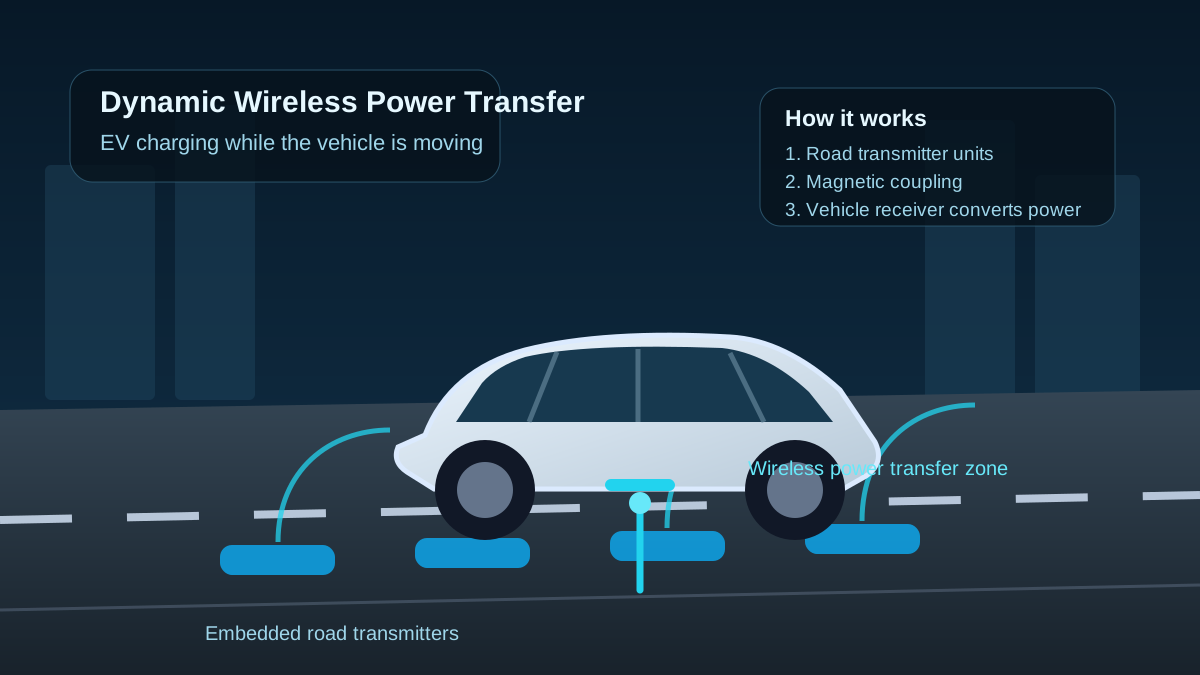
DWPT = wireless charging while driving. A roadway creates a controlled magnetic field, and a receiver underneath the EV converts the transferred energy into electrical power for the vehicle.
How does dynamic wireless EV charging work?
A DWPT road places power-transmitter units beneath or inside the road surface. When a compatible EV passes above them, magnetic coupling transfers energy across the air gap to a receiver installed on the vehicle. Power electronics then condition that energy for the vehicle's electrical system and battery.
This is different from static wireless charging, where the vehicle parks over a charging pad. With DWPT, power transfer happens while the vehicle is travelling.
What did Honda announce in October 2026?
On October 5, 2026, Honda R&D, Taisei Corporation and Taisei Rotec announced underlying technology for a magnetic-coupling Wireless Power Transfer road system designed for vehicles ranging from passenger EVs to large commercial EVs. Honda says the partners plan public-road demonstration testing from Japanese fiscal 2027, which begins April 1, 2027.
The system combines a Honda-developed DC-distribution ground assembly and vehicle receiver, a high-response DC power supply from Taisei, and pavement/installation technology from Taisei Rotec.
| Honda DWPT program detail | Confirmed status |
|---|---|
| Public-road demonstration | Planned from Japanese fiscal 2027 onward |
| Target vehicles | Passenger EVs through large commercial EVs |
| Heavy-vehicle design target | Road structure tested for traffic including vehicles around 20 tonnes gross weight |
| High-power target | Honda plans verification at up to 150 kW for large commercial vehicles |
| Late-2026 testing | Dedicated test road planned for durability, DWPT performance and electromagnetic-field leakage evaluation |
Why would anyone charge an EV while it is moving?
The main benefit is reducing how often a vehicle has to stop for charging. That can matter most for commercial vehicles that operate for long hours, such as logistics trucks, buses or other high-utilization fleets.
In theory, frequent access to powered road sections could also reduce the amount of battery capacity a vehicle needs for a given duty cycle. In practice, whether that makes economic sense depends on road infrastructure cost, energy pricing, compatible vehicles and how much of a route is electrified.
Does the whole road have to be electrified?
No. DWPT can be deployed in selected road sections rather than every kilometre of a network. High-use freight corridors, bus lanes, depots, ports or repeated routes are often easier use cases to justify than electrifying ordinary roads everywhere.
Honda's current program is still in the testing and validation stage. It should not be interpreted as a commercially available nationwide charging-road network.
Is DWPT as powerful as a fast-charging station?
They solve different problems. A stationary DC fast charger can deliver very high power while the vehicle is stopped. DWPT delivers power during movement and must cope with alignment, road durability, installation depth, vehicle speed, electromagnetic limits and repeated short periods of coupling.
Honda says its development program will verify output levels up to 150 kW for large commercial vehicles. That is far below today's most extreme megawatt EV charging headlines, but the vehicle would receive energy without stopping.
What are the disadvantages and engineering challenges?
- Infrastructure cost: power electronics and transmitter units must be embedded in roads.
- Road durability: embedded equipment must survive heavy traffic, weather, repairs and resurfacing.
- Vehicle compatibility: EVs need suitable receiver hardware and control electronics.
- Efficiency and alignment: the air gap and vehicle position affect magnetic coupling.
- Grid capacity: heavily used powered roads could create large local electricity demand.
- Standards: interoperable vehicle-road systems matter if DWPT is to scale beyond proprietary demonstrations.
- Electromagnetic safety: systems must control field leakage and meet applicable exposure requirements.
Dynamic wireless charging vs static wireless charging
| Dynamic wireless charging | Static wireless charging | |
|---|---|---|
| Vehicle state | Moving | Parked |
| Infrastructure | Road-embedded transmitter sections | Charging pad at a parking space |
| Primary benefit | Energy without stopping | Plug-free charging convenience |
| Complexity | Very high: road, vehicle and grid integration | Lower: fixed parking alignment |
Should EV buyers care about DWPT yet?
For most private-car buyers in 2026, DWPT is still an emerging infrastructure technology rather than a feature that should determine which EV to buy. The near-term relevance is stronger for commercial fleets and transport operators.
However, the term is worth understanding now because major automakers and infrastructure companies are moving from laboratory research toward public-road demonstrations. If those tests succeed, DWPT could become another branch of the EV charging ecosystem alongside home AC charging, DC fast charging, bidirectional charging and battery swapping.
Related terms
Sources
- Honda — in-motion wireless charging underlying technology, October 5, 2026
- Honda — Japan Mobility Show Bizweek 2026 DWPT exhibit overview
- Reuters — Honda plans highway test of wireless charging for moving trucks, October 5, 2026
Honda has announced technology development and future demonstration testing. CarGlossary does not describe this as a commercially deployed public charging road.