EV infrastructure · China · Updated October 17, 2026
Mobile EV Charging Trucks Explained: How China's Giant Battery Trailers Tackle Charging Queues
Instead of waiting for a permanent charging station to be expanded, operators can bring stored electricity directly to busy highway rest stops. China's holiday-travel deployments show how mobile battery trailers can add temporary EV charging capacity.
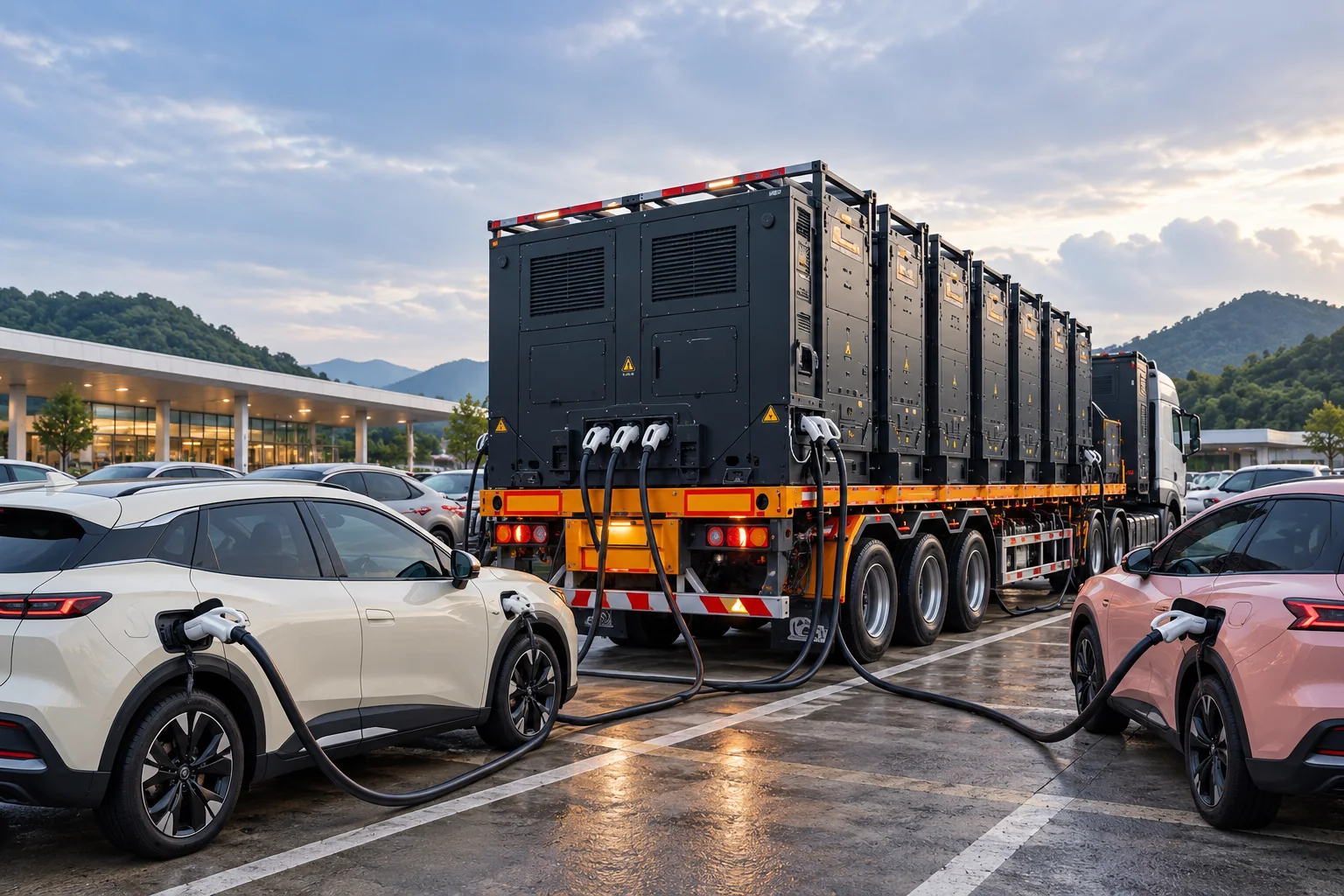
What is a mobile EV charging truck?
A mobile EV charging truck is a vehicle or trailer carrying a battery energy storage system (BESS), power conversion electronics, cooling, protection systems and charging connectors. It delivers electricity to parked EVs without requiring every charging session to draw power directly from a newly built high-capacity grid connection. Some systems recharge their batteries at a depot or another suitable electrical connection before moving to the next site.
How does battery-powered mobile fast charging work?
- Charge the trailer battery: Operators replenish the onboard energy store where sufficient power is available.
- Move to demand: A truck positions the system at a highway service area, event or emergency site.
- Convert and control power: Inverters, DC charging hardware, battery management and cooling deliver compatible energy to EVs.
- Recharge or rotate units: Once depleted, the equipment needs replenishment or replacement with a charged unit.
Mobile charging is not energy generation. It moves stored electricity in time and place. Battery size is measured in kWh or MWh; charging output is measured in kW. A 3,000 kWh battery theoretically contains enough energy for sixty 50 kWh top-ups, but actual sessions will be fewer after reserve margins, conversion losses and operating constraints.
Why China is using mobile chargers at highway rest stops
Holiday travel creates sharp, short-lived demand spikes. Jiangsu's October 2026 government report described more than 60 mobile charging terminals deployed across 30 busy service areas, plus over 300 additional charging connectors ahead of peak travel. It reported 3,166 emergency charging services and 76,900 kWh supplied during the holiday period. Those provincial totals cover broader mobile charging deployments and should not be attributed solely to Dianlala's giant battery trailers.
Separately, reporting from May 2026 describes Jiangsu Dianlala's upgraded high-capacity mobile energy equipment at the Huangqiao service area on the Yanjing Expressway. Its modular batteries were described as shareable across passenger-car charging, electric heavy-truck battery swapping and emergency storage uses.
Mobile battery trailer versus a fixed fast charger
| Question | Mobile battery trailer | Permanent fast charger |
|---|---|---|
| Best use | Temporary peaks, events, emergency support | Predictable daily demand |
| Site work | Potentially less civil construction | Often needs grid connection and installation |
| Energy source | Finite onboard battery that must be replenished | Continuous grid supply, subject to site limits |
| Limitations | Transport, storage losses, battery wear and logistics | Grid upgrade costs, land and permitting |
Could this work in the US, Canada, Europe or Australia?
Potentially. Seasonal highway traffic, remote events, disaster response and temporary fleet operations all create use cases for mobile charging. Whether it is economically attractive depends on utilization, electricity purchase prices, logistics, equipment capital costs, safety requirements and local charging standards. The Chinese deployments do not establish that identical trailers are already commercially available or approved in every international market.
Is mobile charging safe?
Large battery trailers require thermal management, fire-risk controls, electrical isolation, emergency shutdown procedures, transport compliance and site-specific operating rules. Connector compatibility and charging protocols matter. Viral claims that a particular manufacturer's heavy-truck battery interface was incorporated into an IEC standard should not be treated as confirmed without a specific, verifiable standard and official documentation.
Does it eliminate EV charging queues?
It can reduce queues by temporarily adding charging capacity, but it does not eliminate congestion or guarantee a charging speed. Available battery energy, simultaneous charging ports, vehicle acceptance rates and turnaround logistics all impose limits.
Frequently asked questions
Can a mobile charger charge several EVs at once?
Yes, if it has multiple compatible outputs and sufficient total power. Per-car speed may drop when several vehicles share one system.
Can these trailers fast-charge a stranded EV?
Some systems can provide roadside or site-based emergency charging, subject to safe access, connector compatibility and local service availability.
Is battery swapping the same as mobile EV charging?
No. Battery swapping replaces a vehicle battery module; mobile charging delivers electricity through a charging cable. Some battery ecosystems support both functions.
How many cars can a 4 MWh trailer charge?
It depends on starting battery levels and delivered energy per car. At 50 kWh per top-up, 4,000 kWh divided by 50 equals 80 theoretical sessions before losses and reserves—not a guaranteed real-world throughput figure.
Explore related CarGlossary guides
Learn about 800V EV architecture, ultra-fast charging and battery health, and browse more automotive technology guides.
Sources
- China Jiangsu Net, May 2, 2026 — Dianlala deployment and reported technical specifications
- Jiangsu Provincial Government, October 9, 2026 — holiday mobile charging deployments and results
- Jiangsu Provincial Government, September 27, 2026 — pre-holiday charging capacity measures
- Hunan Provincial Government, February 16, 2026 — mobile charging vehicles at service areas