Engine oil and many other vehicle fluids need scheduled replacement, but not at one universal mileage. Brake fluid can be time-sensitive, coolant has its own long-term schedule, transmission and differential fluids depend on the drivetrain, and cars with electric power steering generally have no power steering fluid. Refill-only fluids such as windscreen washer fluid are different.
Where do car fluids work?
Explore six major systems in this illustrated vehicle cutaway.
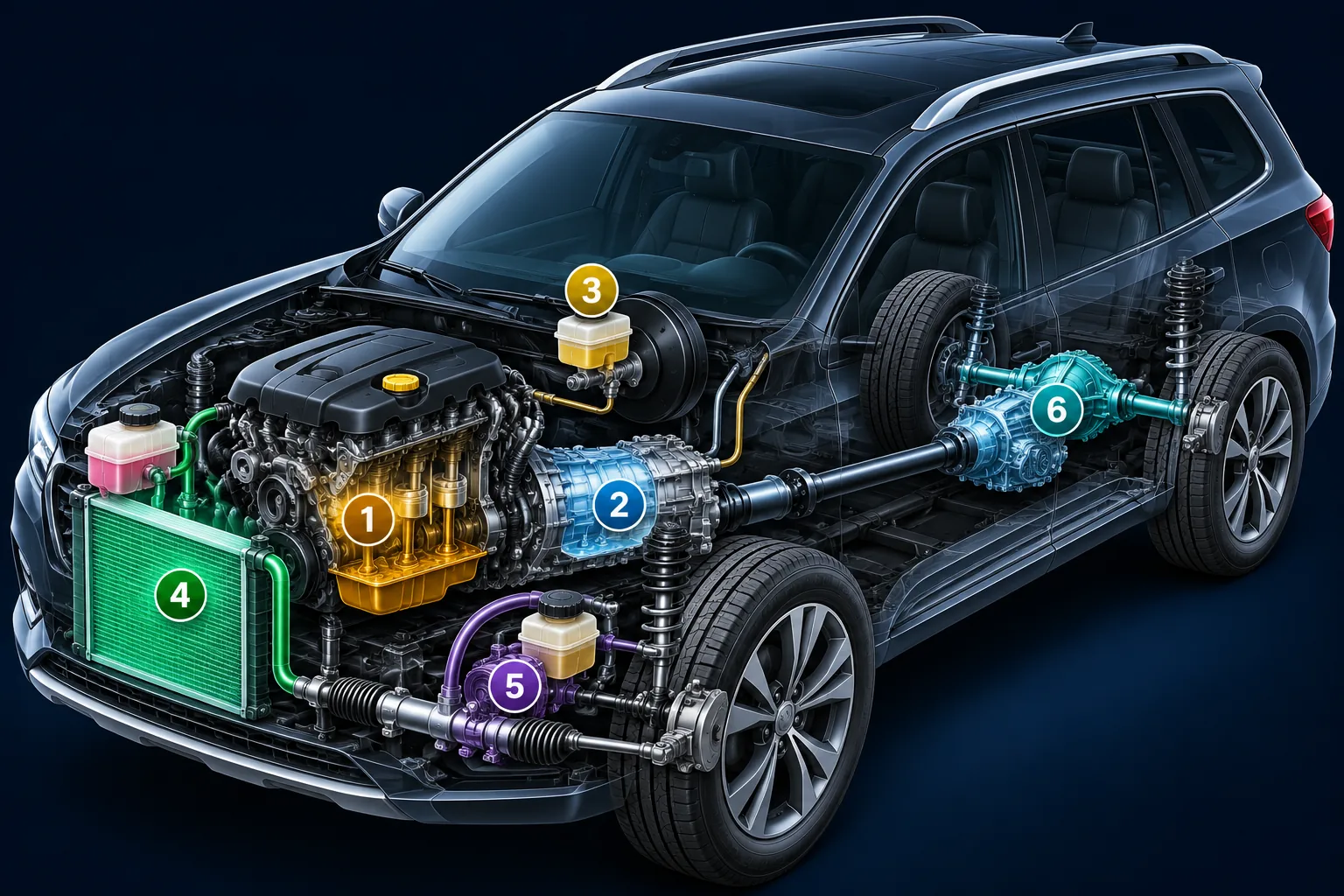
Where does each fluid do its job?
Which car fluids need changing?
This table describes the type of maintenance, not a fixed change interval for every car. A handbook may require inspection, replacement, or both.
| Fluid | Typical approach | When? | If ignored |
|---|---|---|---|
| Engine oil + filter | Replace regularly | Oil-life monitor or the exact time/mileage schedule, whichever applies. Change the filter as directed. | Lubrication loss, sludge, accelerated wear and possible engine damage. |
| Gearbox / transmission fluid | Vehicle-specific | Automatic, CVT, DCT and manual gearboxes use different fluids and schedules; severe use can change the interval. | Poor shifting, heat, clutch or bearing wear and potentially expensive repairs. |
| Brake fluid | Replace periodically | Often time-based; exact interval depends on the model. Do not infer it from fluid color alone. | Moisture and degraded fluid may contribute to corrosion and reduced braking performance under heat. |
| Engine coolant | Replace on schedule | First-fill and later replacement intervals differ widely by coolant chemistry and vehicle. | Corrosion, reduced cooling protection and possible overheating. |
| Power steering fluid | Only if hydraulic | Check whether the car has hydraulic steering. Many electric power steering systems have no steering-fluid reservoir. | Low or contaminated hydraulic fluid can damage the pump or steering components. |
| Differential / transfer case oil | Depends on drivetrain | For equipped vehicles, use the specified drivetrain-fluid interval and severe-duty schedule. | Gear and bearing wear, overheating and driveline noise. |
| Hydraulic clutch fluid | If equipped | Some manual cars use brake-type fluid in a shared or separate hydraulic clutch circuit; follow its manual. | Leaks, corrosion, or difficulty disengaging the clutch. |
| Windshield washer fluid | Top up as needed | Refill when low, using a suitable washer-fluid formulation for the climate. | Poor windscreen cleaning and visibility rather than drivetrain wear. |
Maintenance schedule & service tracker
Check what to inspect, then record your own car’s last service and next due date.
A useful schedule distinguishes regular replacement from inspection and equipment-dependent service. These are reminders to consult the manual, not generic oil-change mileage promises.
Four maintenance decisions
Oil level, washer fluid, coolant reservoir and any hydraulic fluid the car actually uses.
Use the vehicle's schedule or oil-life message and its time limit.
Follow the exact brake-fluid service deadline, even on low-mileage cars.
Check normal versus severe schedules and whether each system exists.
Your editable maintenance log
Tap any blank cell to enter a date, mileage or next due service. Check your car’s manual for the actual interval.
| Fluid / system | Last service date | Odometer | Next due: per manual |
|---|---|---|---|
| Engine oil + filter | |||
| Brake fluid | |||
| Engine coolant | |||
| Transmission fluid | |||
| Steering (if hydraulic) | |||
| Differential / 4WD (if fitted) |
You can type into the blank cells for this visit. Entries are not saved after the page reloads. Save or print the page if you want to keep the record.
Check, top up, or replace: what's the difference?
Inspect condition and level
Look for the correct fluid level, leaks, warnings or contamination according to the manual. Some sealed systems require professional checks.
Add the correct fluid
Restores the level when allowed. It does not remove aged fluid or repair the reason for a persistent loss.
Drain or exchange old fluid
Removes used fluid and installs the manufacturer-specified fluid, typically with a defined procedure and sometimes a filter.
A low brake-fluid or coolant level may indicate a leak or another fault. Do not assume repeated topping up is normal.
Every major fluid, in plain language
Choose the system that your car actually uses. A front-wheel-drive petrol hatchback, a 4WD SUV and a battery-electric vehicle will not have identical service requirements.
Engine oil & filter
Lubricates, cleans and helps cool internal combustion-engine components.
When to serviceUse the manufacturer-approved viscosity and performance specification; replace at the oil-life or calendar/mileage interval. Low oil is an urgent condition, not something to solve by waiting for the next service.
What happens if ignored?Old or insufficient oil raises friction and wear; prolonged neglect can create deposits or severe engine damage.
Read the full engine-oil guide: grades, types and change intervals →
Gearbox / transmission fluid
Provides lubrication and, depending on the design, hydraulic control, cooling and friction behavior.
When to serviceAutomatic, torque-converter, CVT, DCT and manual systems are not interchangeable. Never substitute ordinary ATF for a specified CVT or DCT fluid. Follow the exact service procedure.
What happens if ignored?Neglect can contribute to harsh operation, overheating or gear/clutch damage.
Compare ATF, CVT, DCT and manual gearbox fluids → · Further reading: how a CVT works and CVT problems and maintenance.
Brake fluid
Transfers pedal pressure through the hydraulic braking system.
When to serviceBrake fluid is a safety item with a time-based maintenance component on many cars. Never mix incompatible fluid types or top up repeated losses without diagnosis.
What happens if ignored?Moisture, overheating or leaks can compromise braking; a soft pedal requires prompt attention.
Engine coolant / antifreeze
Carries heat away from the engine and helps protect the cooling system from corrosion and freezing.
When to serviceUse the approved chemistry and mixture. Different colors do not reliably identify compatible formulas. Never remove a hot pressurized coolant cap.
What happens if ignored?Overheating and corrosion can damage radiators, pumps, hoses or the engine.
Power steering fluid
Hydraulic steering systems use pressurized fluid to help turn the wheels.
When to serviceElectric power steering (EPS) has no hydraulic steering-fluid reservoir. If your car has hydraulic steering, use the specified fluid and check for leaks.
What happens if ignored?A low level or incorrect fluid can increase steering effort and damage hydraulic components.
Power steering fluid: hydraulic vs EPS, service and troubleshooting →
Differential & transfer case oil
Lubricates gears and bearings that distribute power between wheels and axles.
When to serviceRelevant to many AWD/4WD and some rear-wheel-drive cars. It is not automatically the same fluid as the gearbox oil.
What happens if ignored?Contamination or loss of lubrication can produce noise, overheating and costly driveline wear.
AWD/4WD differential & transfer case oil: intervals and types →
Hydraulic clutch fluid
Operates the clutch release system in some manual-transmission cars.
When to serviceThe system may share a brake-fluid reservoir or use a separate one; identify the correct circuit and service requirements.
What happens if ignored?Fluid loss, leaks or deterioration can cause poor clutch release.
Windshield washer fluid
Cleans the windscreen so the driver can see clearly.
When to serviceRefill as needed; unlike engine oil it is not normally a scheduled drain-and-replace service.
What happens if ignored?An empty reservoir can leave the windscreen difficult to clean.
How often should you change each fluid?
Start with the manufacturer's maintenance schedule for the exact vehicle. It may use distance, time, an oil-life indicator, or special conditions—whichever comes first when the schedule says so. A generic “every 10,000 km for everything” rule is not reliable.
- Identify the vehicle: manufacturer, model, model year, engine/powertrain, gearbox and sales market.
- Look up the fluid specification: grade, standard, chemistry and any manufacturer approval—not just its color or brand.
- Check normal versus severe service: towing, mountain driving, dusty use, repeated short trips and extreme temperatures may affect some schedules.
- Use the relevant deadline: time, distance, dashboard maintenance reminder or a condition-based requirement.
- Record the service: date, odometer, fluid specification, quantity and filter changes.
Real manufacturer examples — not universal intervals
Honda (U.S. guidance)
American Honda says that when its oil maintenance reminder has not appeared after 12 months, the engine oil should be changed; it also specifies brake-fluid replacement at three years if the reminder has not requested it sooner. Other models and markets may differ.
Nissan Rogue (2026, U.S.)
Nissan lists CVT-fluid inspections every 7,500 miles (about 12,100 km) or 12 months for standard driving, with a 60,000-mile (about 96,600 km) replacement under its listed severe conditions. This is a Rogue-specific example, not a rule for all CVTs.
For hot climates, stop-and-go use and dusty roads, check which operating conditions your own manual defines as severe. Hot weather alone does not justify inventing a shorter oil interval.
Real car example: one model, six different service rules
One vehicle shows why a universal “change every 40,000 km” chart is unreliable. The following comes from the 2025 Kia Sportage AWD, Canada, Smartstream G2.5 GDi manufacturer's schedule. Treat it as a worked example, not a service recommendation for another Sportage, engine or country.
| Fluid | 2025 Kia Sportage AWD · Canada |
|---|---|
| Engine oil and filter | Normal schedule: every 13,000 km or 12 months; certain severe conditions: 8,000 km or 6 months. |
| Brake fluid | Inspect every 13,000 km or 12 months; replace every 78,000 km or 48 months. |
| Coolant | First replace at 195,000 km or 120 months; then every 39,000 km or 24 months. |
| Automatic transmission | Normal schedule lists no service required; under specified severe conditions, replace at 91,000 km. |
| Rear differential (AWD) | Inspect every 65,000 km or 48 months; specified severe use: replace at 117,000 km. |
| Transfer case (AWD) | Same inspection/replacement thresholds as this model's rear differential; replace affected fluids after submersion. |
Source: Kia Canada's official 2025 Sportage maintenance chart. Normal and severe intervals, “inspect” versus “replace,” and equipment availability are distinct. Always consult the exact current manufacturer information for your VIN and market.
Do you need an engine flush or a machine cleaning service?
See our detailed engine flushing evidence guide for the difference between oil changes, chemical and machine flushing, manufacturer positions and risks.
An oil change replaces old lubricant. A chemical or machine flush attempts to remove internal deposits. A flush cannot restore worn piston rings, bearings or other damaged mechanical parts, and advertised fuel-economy or “like-new engine” claims should not be assumed.
Routine flushing is not automatically part of scheduled maintenance. American Honda's 2019 service position explicitly advises against engine oil-system flushing as routine maintenance for its vehicles. Abnormal contamination or oil-pressure problems call for diagnosis and a vehicle-specific repair plan—not an automatic cleaning upsell.
For chemical additives, machine flushing, blocked oil passages and when targeted cleaning may be appropriate, read our full engine-flushing guide. Follow the vehicle schedule and ask for a documented diagnosis and approved method before purchasing extra cleaning.
What changes for hybrids and electric cars?
Hybrids: A hybrid with an internal combustion engine still needs engine oil, even if the engine sometimes shuts off in traffic. Its transmission and coolant circuits may be different from those of a conventional car.
Battery-electric vehicles: No combustion engine means no engine-oil change, but many EVs still use brake fluid, special cooling circuits and gear-reduction lubricants. Service methods and intervals are model-specific, and high-voltage cooling systems are not safe DIY work.
Air-conditioning refrigerant: This is part of a sealed climate-control system, not a regular “oil-change” fluid. Refrigerant loss or poor cooling should be diagnosed; routine regassing without a fault is not a universal maintenance requirement.
Frequently asked questions
Does every car need a power steering fluid change?
No. Cars with electric power steering (EPS) do not have a hydraulic steering-fluid reservoir. Older or other hydraulically assisted steering systems may require fluid inspection or service.
Can I use the same oil in my engine and gearbox?
Not unless the exact vehicle manufacturer explicitly specifies the same approved product for both systems. Engine oil, automatic transmission fluid, CVT fluid and gear oils serve different purposes and often have incompatible properties.
If the fluid looks clean, can I skip changing it?
Not reliably. Color alone does not show whether additives, corrosion protection, moisture content or other required fluid properties are still acceptable. Follow the maintenance schedule and any required tests.
Is “lifetime transmission fluid” truly forever?
The term depends on the manufacturer and its defined service life and operating conditions. Some transmissions have inspection or severe-use replacement rules even when the regular schedule has no fixed change point. Verify the exact model and gearbox rather than guessing.
Can an engine flush make an old engine like new?
No. Removing some deposits is not the same as reversing cylinder, bearing, seal or piston-ring wear. A service should be justified by evidence of a problem and an approved method, not a generic restoration claim.
The eight-guide series, in pictures
These editorial previews show how the guides fit together. For actual fluid specifications and maintenance intervals, use the detailed articles and your vehicle manual.
View the series infographics (2 images)
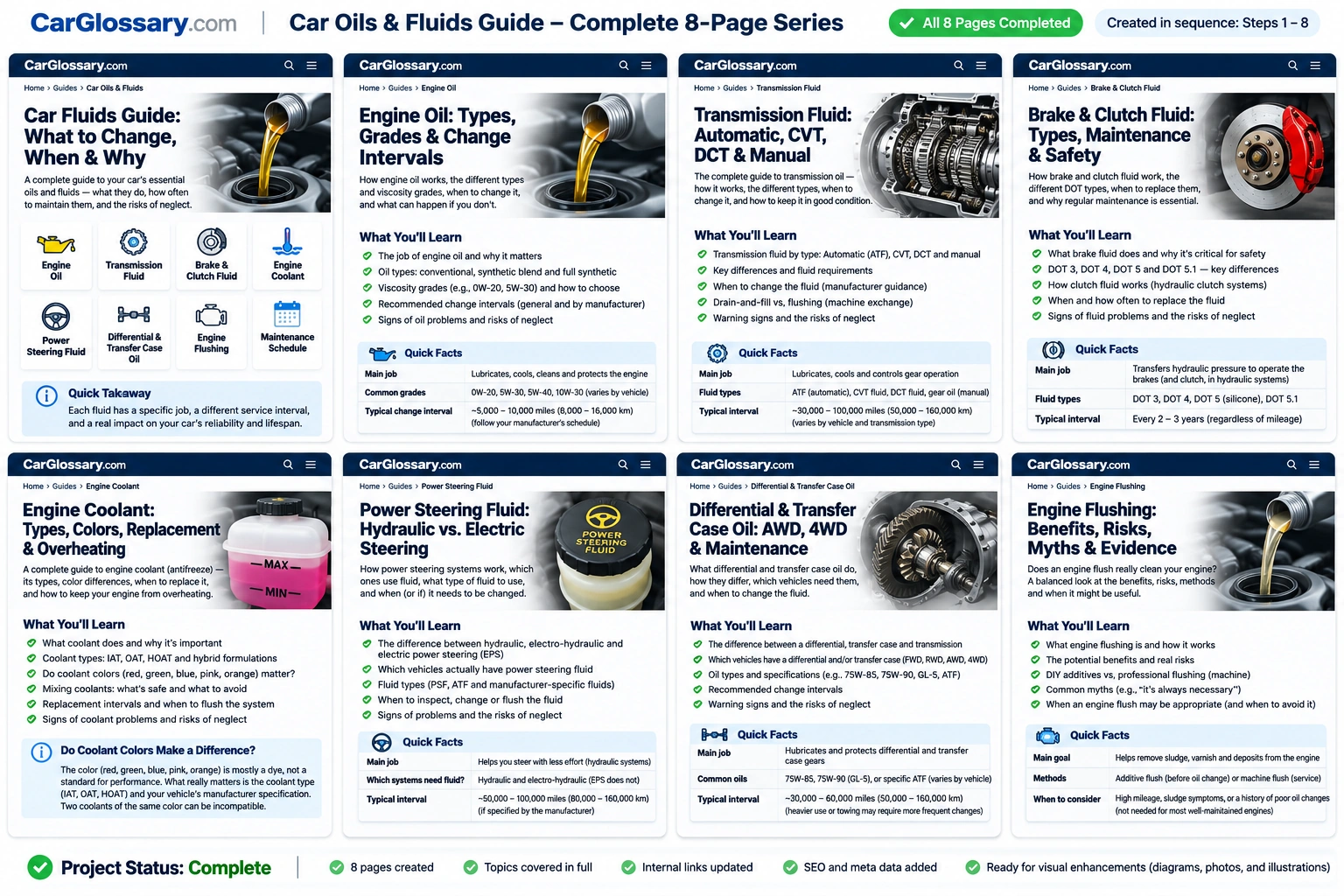
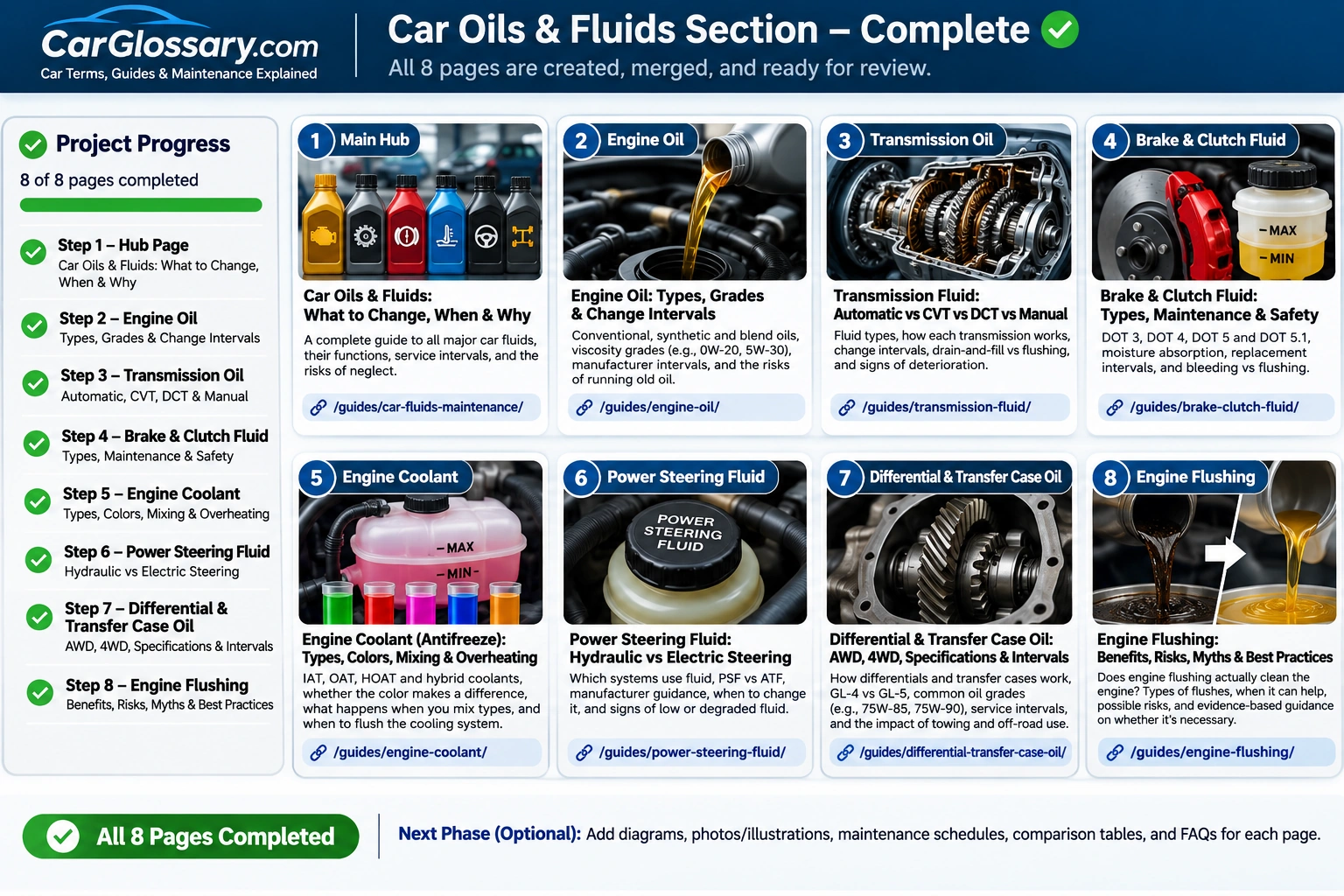
Editorial artwork only. The screenshots and example mileage figures in these graphics are illustrative, not live site screenshots or manufacturer-approved service intervals. The individual articles and official vehicle manuals take precedence.
Sources and verification
Manufacturer instructions take precedence over this general guide. Example schedules below are specific to their stated U.S. vehicles or manufacturer guidance and must not be transplanted to another model or country.
- American Honda — Maintenance Minder codes and time-based guidance.
- Nissan USA — 2026 Rogue CVT fluid intervals.
- Toyota USA — 2025 Camry warranty and maintenance guide (normal vs special operating conditions).
- American Honda — 2019 position statement on additives, fluids and flushes.
- AAA — Practical car maintenance and oil service overview.