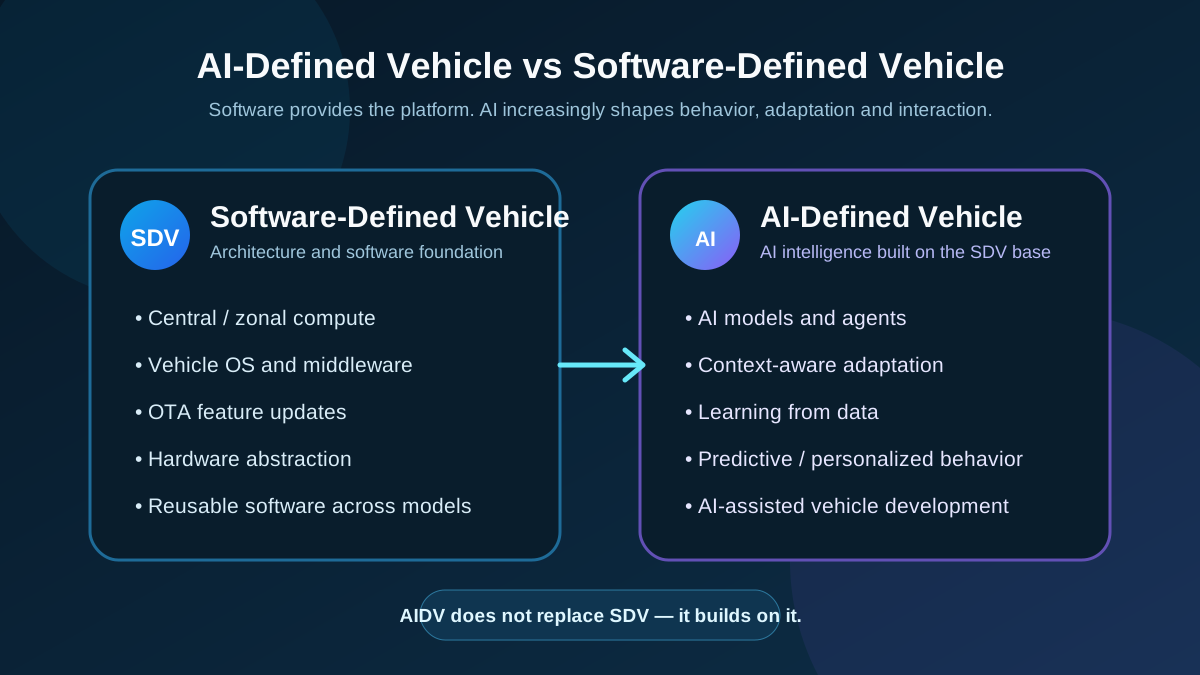
AIDV does not replace SDV. An AI-defined vehicle still needs the software-defined architecture, compute, data pipelines and update mechanisms that let AI models be deployed, validated and improved across the vehicle lifecycle.
What changed on October 6, 2026?
Two announcements from Applied Intuition made the distinction unusually clear. Nissan expanded its work with Applied Intuition to support AI-defined vehicle development using Vehicle OS and AI-native development tooling. The companies said the work supports Nissan's scalable, open next-generation in-vehicle software platform and aims to shorten software-development timelines.
On the same day, Applied Intuition announced a separate partnership with Honda focused explicitly on a software-defined vehicle platform: centralized, upgradable and designed to support Honda's next-generation vehicle architecture across multiple powertrains.
The announcements do not mean Nissan has abandoned SDV or that Honda is avoiding AI. Nissan itself says its AI-defined vehicle is built on an SDV foundation. The useful distinction is architectural emphasis: SDV establishes the software platform; AIDV describes what happens when AI becomes a deeper part of vehicle behavior and development.
AIDV vs SDV at a glance
| Area | Software-Defined Vehicle (SDV) | AI-Defined Vehicle (AIDV) |
|---|---|---|
| Core idea | Vehicle functions increasingly controlled and updated through software. | AI increasingly shapes functions, behavior, decisions and user interaction. |
| Foundation | Central/zonal compute, Vehicle OS, middleware, OTA updates, hardware abstraction. | Uses the SDV foundation plus AI models, agents, data pipelines and AI tooling. |
| How features evolve | Engineers deploy software and feature updates. | Software still updates, while AI models can adapt behavior using data and context. |
| Typical examples | OTA updates, common software platform, centralized compute, reusable services. | Context-aware assistants, adaptive driving intelligence, predictive personalization, AI-assisted development. |
| Formal standard? | No single universal SDV certification. | No; AIDV is an emerging industry term, not an SAE automation level. |
How Nissan defines an AI-defined vehicle
Nissan's own technology material says its AIDV concept is built on the software-defined vehicle foundation. It describes two major AI areas: AI-Drive, which is intended to perceive surroundings, predict conditions and support driving decisions; and AI-Partner, which is intended to understand driver and passenger context and improve interactions, information and services.
Nissan's Scalable Open Software Platform is the underlying SDV platform. Nissan says it includes an in-vehicle system, vehicle OS and cloud-based development/data foundation designed to support updates, new capabilities and faster AI evolution.
What Honda's announcement shows about SDV
Honda's October 6 partnership focuses on the infrastructure side of the transition: a centralized, upgradable platform that can support next-generation vehicle architectures and multiple powertrains. That is classic SDV territory — common software foundations, faster development, lower duplication and the ability to evolve features after production.
Does AIDV mean the car is autonomous?
No. AI-defined vehicle and software-defined vehicle describe architectural and product-development directions. They do not assign an SAE automation level. A car can use extensive AI and still require a human driver for all driving responsibility.
What buyers should actually look for
Marketing labels alone are not enough. For a real vehicle, ask whether the manufacturer clearly states the software-support period, OTA scope, hardware capability, privacy/data policies, driver-assistance limitations, cybersecurity process and which AI functions actually ship in the relevant market and trim. “AI-defined” is meaningful only when those capabilities are implemented and supported in production.
Why this matters for CarGlossary
AIDV is moving from supplier terminology into mainstream automaker strategy. Nissan now uses the term directly, while major technology companies such as Qualcomm, Arm and RISC-V International are also describing AI-defined vehicles as an evolution of the SDV concept. That makes AIDV vs SDV a useful emerging distinction to track rather than a one-day news headline.
Related terms
Sources
- Applied Intuition — Nissan AI-defined vehicle development collaboration, October 6, 2026
- Applied Intuition — Honda software-defined vehicle partnership, October 6, 2026
- Nissan — AI-defined vehicle, AI-Drive and AI-Partner
- Nissan — Scalable Open Software Platform and SDV foundation
The October 6 partnership announcements describe development direction and tooling. They do not by themselves confirm a production date, a specific retail model, or that every described AI capability is available to customers today.