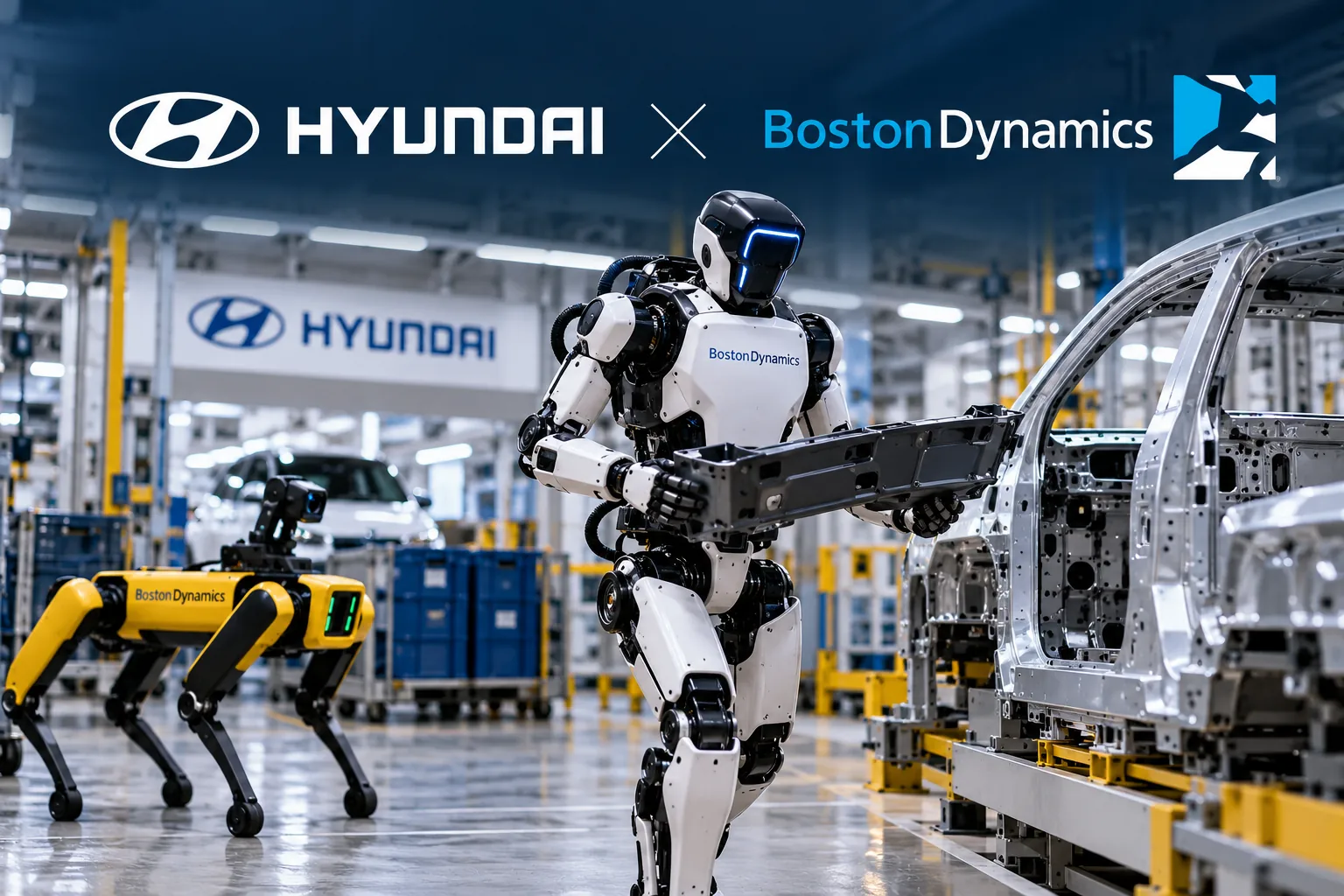
Hyundai completed its controlling-interest acquisition of Boston Dynamics in June 2021. By 2026, Boston Dynamics had introduced the product version of its all-electric Atlas humanoid robot and begun training robots for automotive manufacturing at Hyundai's Georgia campus. Large-scale production-line deployment is still a future target, not an already completed rollout.
Does Hyundai own Boston Dynamics?
Yes. On June 21, 2021, Hyundai Motor Group announced that it had completed an acquisition giving the group an 80% stake in Boston Dynamics from SoftBank. The transaction valued Boston Dynamics at approximately US$1.1 billion. Boston Dynamics remained a separately operating robotics business within Hyundai's broader group.
Ownership has a 2026 update: on July 16, 2026, Hyundai said relevant group shareholders were pursuing the acquisition of SoftBank's remaining stake and reviewing the associated approval process. That statement does not establish that Hyundai already completed a purchase of the final 20%. The 80% figure remains the last confirmed completed ownership split in the cited announcements.
Why would a car company buy a robotics company?
How Hyundai intends to turn robots into industrial products
The overlap is greater than it first appears. Both a modern vehicle and an industrial robot need sensors, real-time computing, motors, control software, reliable batteries and a way to operate safely around people. Hyundai also owns the manufacturing infrastructure needed to test designs repeatedly and produce sophisticated machines at scale.
- Factory efficiency: robots may handle repetitive, physically demanding tasks such as moving and organizing parts.
- Manufacturing expertise: automotive supply chains already know how to produce electric motors, precision components and complex mechanical systems reliably.
- New business: robots can become products and industrial services in their own right, separate from vehicle sales.
- Shared research: autonomy, perception, control, simulation and Physical AI are relevant to both industrial robots and intelligent vehicles.
That last point needs care: factory robotics is not proof that a Hyundai passenger car will gain autonomous driving capabilities from Atlas software. Their safety requirements and use cases differ.
Meet Boston Dynamics' three key robots
| Robot | Form | Primary purpose | Automotive relevance |
|---|---|---|---|
| Atlas | Two-legged, human-shaped robot | Flexible industrial manipulation and material handling | Being trained for parts sequencing; later assembly work is planned |
| Spot | Four-legged mobile robot | Inspection, monitoring and data collection | Facility inspection and manufacturing quality-monitoring applications |
| Stretch | Wheeled warehouse robot with a handling arm | Box movement and unloading | Automation of logistics that feed manufacturing supply chains |
These are different products, not successive versions of one robot. Atlas is the most relevant to the next stage of Hyundai's manufacturing strategy, while Spot and Stretch already have commercial industrial applications.
What can the 2026 Atlas robot actually do?
Boston Dynamics introduced the product version of the fully electric Atlas at CES in January 2026. Its industrial specifications are striking, but figures must be interpreted correctly.
Boston Dynamics also describes tactile sensing in Atlas's hands, camera-based all-around perception, and an enterprise software platform called Orbit. These support industrial operations and fleet supervision. Published capabilities do not establish unrestricted performance in every real-world factory or task.
Atlas's usefulness will ultimately be judged by task completion, safety, uptime, integration costs and the range of work it can perform—not by how impressive a demonstration looks.
What's happening at Hyundai's Georgia factory in 2026?
This is the part that turns the story into a practical automotive-technology development. Boston Dynamics announced the opening of its Robotics Metaplant Application Center (RMAC) at Hyundai Motor Group Metaplant America, near Savannah, Georgia, on September 21, 2026.
The center trains Atlas on real manufacturing workflows, including parts sequencing: selecting and placing vehicle components in the correct order so they are ready for assembly. The aim is to learn from factory conditions before deploying robots more broadly.
How could a humanoid robot change how cars are built?
Conventional factory robots excel at highly repeatable work inside dedicated cells. A humanoid robot is designed to navigate more human-oriented spaces and potentially handle varied tasks without rebuilding the entire workspace. That versatility is the appeal—but also one of the hardest engineering challenges.
Potential applications include organizing parts, moving material between stations, machine tending and eventually selected assembly tasks. In practice, a robotic humanoid must prove it can perform a task safely, consistently and economically. Traditional automation will remain a better fit for many repetitive, high-throughput operations.
Hyundai's strategy brings together Boston Dynamics' robotics engineering, Hyundai and Kia's manufacturing facilities, Hyundai Mobis' work on actuators and Hyundai Glovis' logistics knowledge. Hyundai has also announced AI collaborations including Google DeepMind and NVIDIA. Partnerships and announced future use cases should not be mistaken for completed product integrations.
What does this have to do with Physical AI and autonomous driving?
Physical AI refers to AI systems that observe and act in the physical world. In a robot, cameras and other sensors inform movement and object handling. In an autonomous vehicle, sensors help interpret roads and other traffic before software commands steering, acceleration or braking.
Both fields need perception, prediction, planning, action and validation. But a warehouse or factory humanoid is not a robotaxi; its control system is not interchangeable with a passenger-car driving stack. Read our Physical AI in vehicles guide for the vehicle-specific technology, or whole-body control for robotics movement.
Will Hyundai customers notice a difference?
Not immediately. This is principally a manufacturing and industrial robotics development, not an announced new feature that buyers should expect in a Hyundai car. Over the longer term, more flexible factory automation could affect productivity, production quality and the way new models are assembled. Whether that leads to lower retail prices, better reliability or faster deliveries is not yet demonstrated.
For car buyers, the useful takeaway is that Hyundai is developing capabilities beyond making vehicles. It is seeking to operate in the broader markets for smart manufacturing, intelligent mobility and industrial AI. That is strategically important without needing to claim a direct customer benefit before evidence appears.
Frequently asked questions
Did Hyundai buy 100% of Boston Dynamics?
The confirmed completed transaction in 2021 gave Hyundai Motor Group an 80% interest. In July 2026 Hyundai said its shareholders were pursuing SoftBank's remaining stake; its statement did not announce a completed buyout.
Is Atlas already building Hyundai cars?
Atlas is being trained for automotive manufacturing tasks at Hyundai's Georgia campus. Hyundai targets production operations beginning in 2028, with more complex assembly applications envisaged for 2030. That is different from saying humanoids currently assemble production vehicles at scale.
Is Atlas the same as Tesla Optimus?
No. Both are humanoid robot projects, but they come from different companies and have different development, manufacturing and commercialization strategies. Direct comparisons require current, verifiable performance data rather than promotional claims.
Does Boston Dynamics build autonomous cars?
Boston Dynamics' main products are mobile robots such as Atlas, Spot and Stretch, not consumer cars. Hyundai's autonomous-driving programs are separate, although some robotics and AI research concepts overlap.
Keep exploring
Sources and verification
Primary sources are linked below. Manufacturer specifications and future milestones are attributed and distinguished from independent performance validation.
- Hyundai Motor Group — Acquisition completed (June 21, 2021)
- Hyundai Motor Group — Statement on remaining SoftBank stake (July 16, 2026)
- Boston Dynamics — Atlas industrial product announcement (January 5, 2026)
- Boston Dynamics — Official Atlas product specifications
- Boston Dynamics — RMAC opening and factory training (September 21, 2026)
- Hyundai — CES 2026 AI robotics strategy and production targets
Updated October 14, 2026. Atlas capacity and endurance are manufacturer specifications, not an independent factory test. Planned 2028 and 2030 milestones are targets. This article does not imply endorsement or affiliation with Hyundai Motor Group or Boston Dynamics. The hero image is an AI-generated concept, not an official product or factory photograph; the process diagram is original HTML.