Before funding a V2X project, ask: Which specific safety or operating problem does the communication solve, and what infrastructure and participating devices are needed? A coverage map alone is not evidence of improved outcomes.
High-value V2X use cases
| Use case | Information shared | Potential benefit | Key dependency |
|---|---|---|---|
| Smart intersection | Signal timing and approaching-vehicle context | More warning time for specific conflicts | Connected signal controller, RSU and compatible vehicle |
| Roadworks / hazard alert | Location and status of a known temporary hazard | Earlier driver awareness | Accurate, timely hazard messages |
| Transit priority | Bus position or priority request | Potential schedule reliability | Traffic authority integration and policy |
| Commercial fleet | Approaching incident, route or road status | Better operational awareness | Equipped fleet, coverage and workflow integration |
| Vulnerable road user | Compatible pedestrian/cyclist presence or alerts | Earlier awareness of specific risks | Supported user device, accurate position and privacy controls |
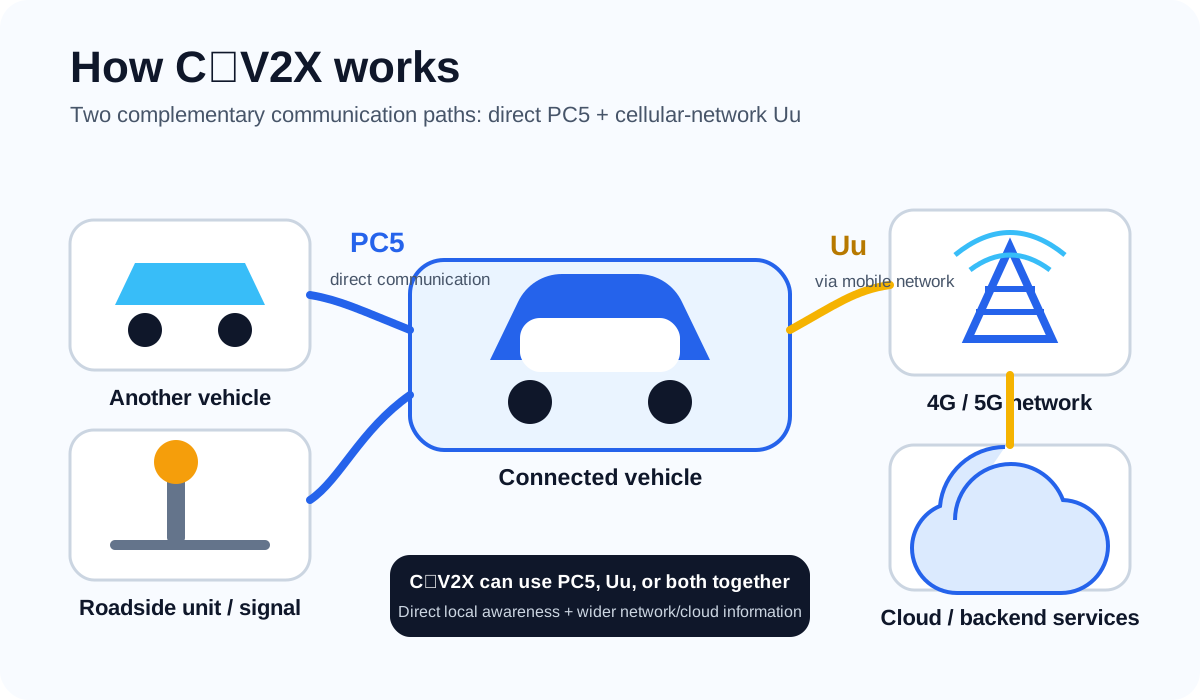
These are potential outcomes, not guaranteed performance. Some cases use direct radio communication; others use a network or cloud platform, and those pathways should not be conflated.
What does a real deployment need?
- Vehicle equipment: on-board units or integrated automaker systems with compatible V2X radios and software.
- Roadside equipment: RSUs, traffic-signal interfaces, sensors and stable power/backhaul.
- Trust and security: message authentication, certificate management, threat monitoring and privacy handling.
- Applications: safety logic, fleet dashboards, incident processing and alert prioritization.
- Operations: maintenance, lifecycle management, testing, uptime monitoring and updated maps.
What is a roadside unit (RSU)?
A roadside unit (RSU) is communications equipment installed near roads or intersections to exchange supported messages with compatible vehicles. An RSU may connect to traffic-signal controllers, sensors or a backend; it cannot deliver every V2X feature without the required vehicle equipment, applications and data.
Where are the commercial opportunities?
Connected-mobility projects may involve OEM suppliers, roadside infrastructure integrators, telecom and edge providers, logistics platforms, cybersecurity companies and specialist software teams. Software layers can expose V2X messages to applications through APIs, support event processing and report message quality. See our explainer of V2X input/output (V2X I/O) as a descriptive software concept, not an established standards name.
Commercial caution: public-sector tenders, installed roadside infrastructure and fleet adoption determine whether a software opportunity is monetizable; a regulatory spectrum decision alone does not establish buyer demand.
How to measure a pilot
- Connectivity: percentage of eligible encounters where compatible messages arrive on time.
- Data quality: location accuracy, stale data, false alerts and missing events.
- Operational outcome: relevant near-miss indicators, response time or travel-time variance.
- Cost: RSU installation, integration, mobile data where used, support and renewal.
- Security: certificate provisioning, revocation, alert handling and system availability.
A pilot should define baseline measurements, operating conditions and success thresholds before procurement; results do not transfer automatically to a different city or fleet.
Regulatory and technical compatibility
Frequency assignments and technology choices vary by country. The U.S. is moving toward C-V2X in part of the 5.9 GHz band; Europe has a technology-neutral ITS framework; China and Saudi Arabia identify their own relevant blocks and conditions. For details, use our worldwide V2X regulatory comparison and C-V2X vs DSRC technical guide.
Questions to ask before buying V2X
Can a fleet become V2X-enabled with software alone?
Not for direct radio-based V2X when the vehicles lack appropriate hardware. Network-based connected services can use different paths, but should be described accurately.
Does V2X replace ADAS or autonomous driving sensors?
No. Communication can complement ADAS, cameras, radar and LiDAR, but is not a replacement for reliable onboard perception and driver attention.
Are smart-city V2X returns guaranteed?
No. Economic value depends on participation rates, safety outcomes, deployment costs and ongoing support.
Related articles
For safety-system integration and realistic limitations, see how V2X can support ADAS and automated driving.
Sources
- U.S. DOT — Vehicle-to-Everything communications
- 5GAA — Dynamic V2X use cases
- China MIIT — vehicle–road–cloud pilots
- Saudi CST — V2X roadmap
Spectrum permissions, equipment approvals and deployment requirements differ by jurisdiction. This explainer is not a licensing determination or legal advice.