All-solid-state battery: a battery in which the electrolyte is solid rather than the conventional liquid electrolyte used in most lithium-ion EV cells. Semi-solid-state battery: a less consistently standardized industry term generally used for a hybrid design that combines solid or quasi-solid electrolyte elements with some remaining liquid or gel component.
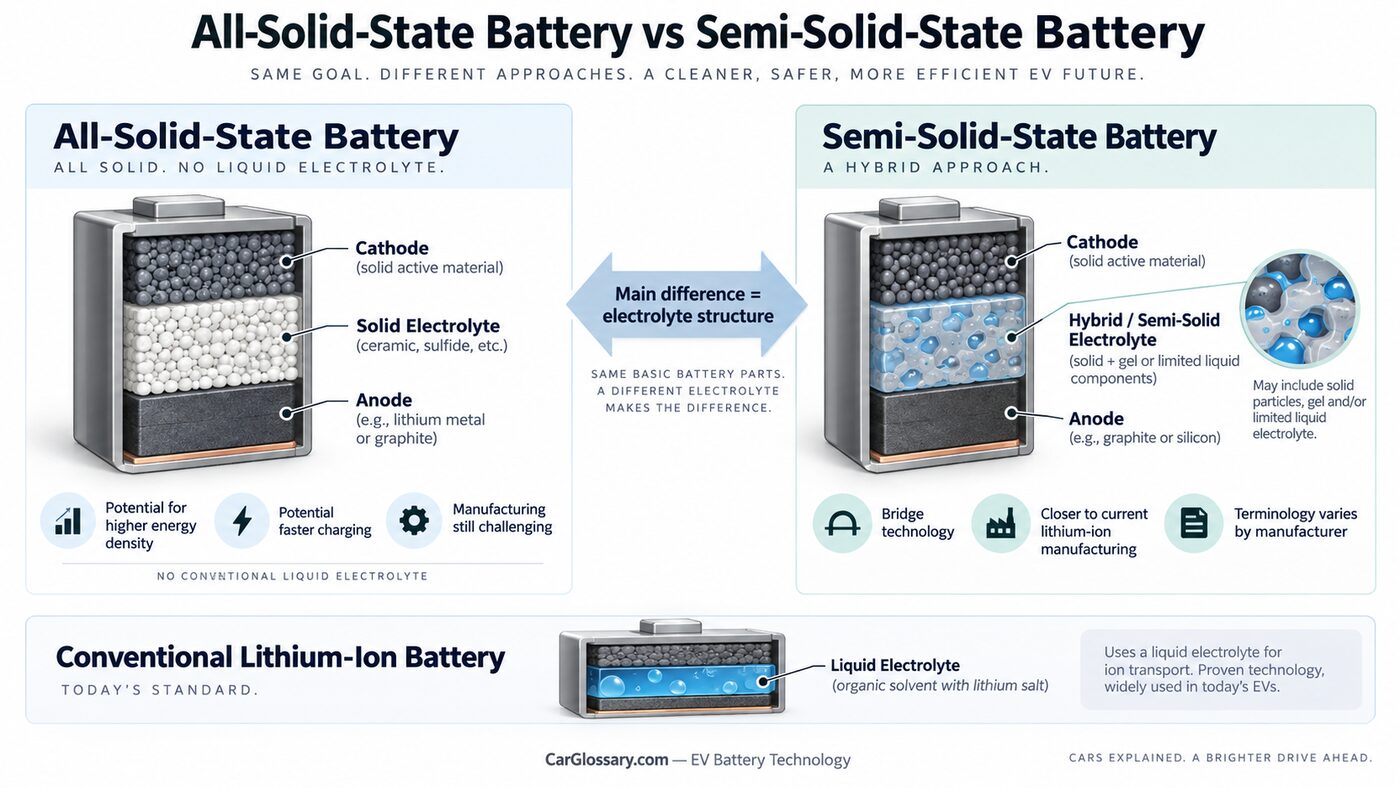
All-solid-state vs semi-solid-state: the key difference
The main distinction is the electrolyte, the material that carries ions between the positive and negative electrodes. Conventional lithium-ion batteries typically use a liquid electrolyte. In an all-solid-state design, ion transport is handled by solid electrolyte material. Semi-solid-state designs sit between the two approaches and may use a mixture of solid, gel-like and liquid components depending on the cell design.
Because “semi-solid-state” is used differently by different companies, buyers should look beyond the label and check exactly what electrolyte architecture the manufacturer describes.
| Feature | All-solid-state battery | Semi-solid-state / hybrid battery |
|---|---|---|
| Electrolyte | Solid electrolyte system | Hybrid system that may retain liquid or gel components |
| Relationship to conventional Li-ion | More fundamental electrolyte change | Often closer to existing lithium-ion manufacturing approaches |
| Potential benefits | Higher energy density, faster charging potential, thermal and safety advantages depending on chemistry and design | May capture some solid-state benefits while easing manufacturing and interface challenges |
| Safety potential | Generally higher in principle because a true all-solid-state cell removes the conventional flammable liquid electrolyte; actual safety still depends on chemistry, interfaces and pack design | Potentially improved over conventional liquid-electrolyte cells, but some designs retain liquid or gel components, so the safety benefit varies |
| Main challenge | Solid-solid interfaces, manufacturability, durability, pressure control, cost and scale | Terminology and performance vary widely by implementation |
| Mass-market passenger EV status | Still in development and pre-mass-market rollout as of September 2026 | More transitional; development and limited implementations vary by company |
How does an all-solid-state battery work?
The basic electrochemical job is still similar to a lithium-ion battery: ions move between the electrodes during charging and discharging. The difference is that the ion-conducting electrolyte is solid. Solid electrolytes under development include sulfide, oxide, polymer and other material systems, each with different conductivity, stability and manufacturing trade-offs.
Why are automakers developing all-solid-state batteries?
Automakers are pursuing the technology because solid electrolytes may support higher energy density, higher output, shorter charging times and improved thermal characteristics. These are potential technology advantages, not guarantees: the actual result depends on the full cell chemistry, pack design, cooling, charging strategy and production quality.
Toyota says its all-solid-state battery program is targeting commercialization around 2027–2028 and has cited shorter charging time and longer cruising-range potential. Honda has built a demonstration production line and says it aims to apply all-solid-state batteries to electrified vehicles introduced in the second half of the 2020s.
What makes all-solid-state batteries difficult?
- Solid-solid interfaces: rigid materials must maintain intimate contact while the cell charges, discharges and changes volume.
- Manufacturing: coating, pressing, stacking and cell assembly need to work at automotive scale and cost.
- Pressure: some solid-state designs benefit from mechanical pressure to preserve interface contact, which complicates pack engineering.
- Material stability: solid electrolytes must remain chemically and electrochemically stable against the electrodes.
- Cost and yield: a laboratory cell is very different from millions of automotive-grade cells produced consistently.
Why use a semi-solid-state battery first?
A semi-solid or hybrid approach can act as a bridge between conventional liquid-electrolyte lithium-ion cells and a fully solid electrolyte system. It can allow battery developers to introduce new anode, electrolyte or energy-density technologies without solving every all-solid-state manufacturing problem at once.
Honda, for example, has separately discussed development of semi-solid-state lithium-metal batteries through its work with SES AI while also developing its own all-solid-state battery technology. That distinction is useful: semi-solid-state and all-solid-state are not interchangeable terms.
Is a solid-state battery the same as a lithium-metal battery?
No. Solid-state describes the electrolyte architecture. Lithium metal describes the anode material. A battery can use a solid electrolyte with a lithium-metal anode, but the terms describe different parts of the cell and should not be treated as synonyms.
Which is safer: all-solid-state or semi-solid-state?
All-solid-state batteries have the stronger safety potential in principle. A true all-solid-state cell removes the conventional flammable liquid electrolyte, reducing risks associated with electrolyte leakage, vapor generation and combustion. Honda describes solid electrolytes as more stable and safer than liquid electrolytes, while the U.S. Department of Energy notes that removing volatile, flammable liquid electrolyte can reduce pressure buildup and deflagration risk during failure.
If two batteries were otherwise equally well engineered, a true all-solid-state battery would generally have a safety advantage over a semi-solid-state battery because it does not rely on the same conventional flammable liquid electrolyte. A semi-solid-state design may still improve safety versus a conventional lithium-ion cell, but the benefit depends on how much liquid or gel electrolyte remains and what chemistry is used.
| Safety factor | All-solid-state | Semi-solid-state |
|---|---|---|
| Conventional flammable liquid electrolyte | Absent in a true all-solid-state design | May still be present in a reduced or gelled form |
| Electrolyte leakage risk | Lower because the electrolyte is solid | Depends on the specific hybrid electrolyte |
| Fire / thermal-runaway potential | Potentially lower, but not eliminated | Potentially lower than conventional Li-ion, but highly design-dependent |
| Overall safety conclusion | Higher theoretical safety potential | Intermediate and implementation-dependent |
However, solid-state does not mean fireproof. A 2026 Nature Communications study on sulfide-based all-solid-state batteries showed that unstable interfaces can still trigger exothermic reactions and thermal runaway. Other risks include lithium dendrites, mechanical damage, internal short circuits, high-energy electrode materials and failures elsewhere in the battery pack.
For buyers, the safest conclusion is therefore: all-solid-state has the best intrinsic safety potential of the three electrolyte approaches, but the safety of a real EV battery must be judged by the complete cell and pack design, testing and certification—not the “solid-state” label alone.
Does solid-state automatically mean faster charging?
No. Solid electrolytes may enable high ion transport and high-power designs, but vehicle charging speed also depends on cell chemistry, pack voltage, temperature, thermal management and the charger. A solid-state battery still needs a charging system designed to exploit its capability. See also C-rate charging and 800V EV architecture.
When will all-solid-state batteries appear in cars?
Timelines differ by manufacturer and should be treated as targets rather than guaranteed launch dates. Toyota has publicly targeted commercialization in 2027–2028. Honda says it is working toward applications in electrified models introduced in the second half of the 2020s. The important buyer distinction today is that all-solid-state technology is moving through pilot and production-engineering stages, but it is not yet a routine mass-market EV specification.
What should buyers check when a car claims “solid-state” technology?
- Does the manufacturer say all-solid-state, semi-solid-state, solid-state or simply “solid electrolyte”?
- Is any liquid or gel electrolyte still present?
- Is the claim about a prototype cell, pilot production, a limited vehicle, or full-scale mass production?
- What are the actual battery capacity, range standard, charging time and cycle-life figures?
- Are the figures measured, homologated or only development targets?
Related terms
Sources
- Toyota — battery technology roadmap and all-solid-state commercialization target
- Toyota & Idemitsu — cooperation toward all-solid-state battery mass production
- Honda — all-solid-state battery demonstration production line
- Honda — semi-solid-state and all-solid-state battery development strategy
- Nature Reviews Materials — solid-state battery electrolytes and material challenges
- Honda — all-solid-state battery safety and electrolyte explanation
- U.S. Department of Energy — Energy Storage Safety Strategic Plan
- Nature Communications — thermal runaway mechanisms in sulfide all-solid-state batteries
“All-solid-state” is the more precise term when describing a fully solid electrolyte architecture. “Semi-solid-state” is less standardized and may refer to different hybrid cell designs, so CarGlossary treats manufacturer-specific claims separately rather than assuming every “solid-state” label means the same technology.