A battery cell is the basic electrochemical unit that stores energy. A module groups cells into a serviceable or structural subassembly in some designs. The complete pack connects cells or modules with cooling, electrical protection, sensors and a battery management system. Not all modern EV packs use separate modules.
Cell, module and pack: the basic hierarchy
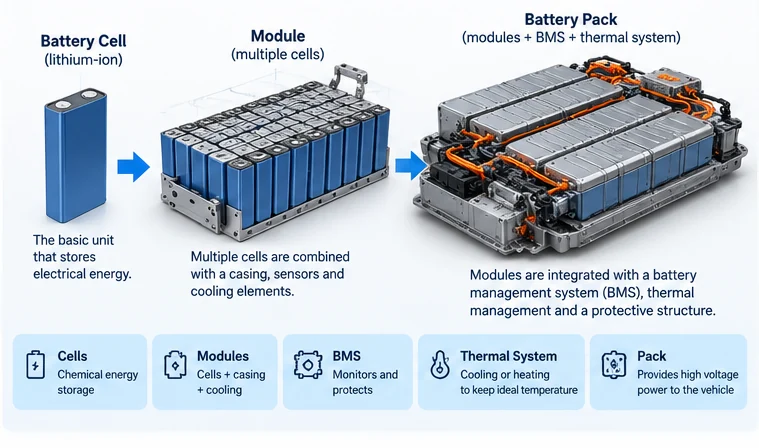
An individual lithium-ion cell produces a limited voltage and stores a limited amount of energy. EVs combine many cells electrically to obtain the voltage and energy needed for driving. A manufacturer may assemble cells into modules and then modules into a pack, but the newer cell-to-pack approach places cells more directly into the pack structure.
Conceptual structure, not an illustration of a specific car. Moduleless packs skip the module step.
What is inside a battery cell?
In broad terms, a rechargeable lithium-ion cell has a positive electrode (cathode), a negative electrode (anode), an electrolyte and a separator. During charging, lithium ions move through the electrolyte; during discharge the direction of ion movement reverses. The electrons travel through the external electrical circuit to supply useful energy.
Cells appear in cylindrical, prismatic and pouch formats. Their physical format is distinct from their chemistry: LFP and nickel-rich chemistries such as NMC can appear in different types of packaging. The best design involves trade-offs between mass, energy density, cost, thermal control and supply chain.
What does a battery module do?
In conventional designs, a module groups cells using electrical connections, mechanical support and often sensing or cooling features. Modules can aid manufacturing and maintenance, but add housings, connectors and other hardware. Module count and replacement practices vary by manufacturer; a module is not automatically user-replaceable.
What does a complete battery pack include?
A pack typically includes cell groups, high-voltage conductors, contactors, current sensing, protective fuses, isolation monitoring, mechanical enclosure, cooling systems and the battery management system (BMS). The pack must withstand normal vibration and appropriate environmental exposure, and it has crash and electrical-safety requirements. Thermal design influences fast charging, cold-weather operation and long-term life.
Cell-to-pack vs cell-to-body
| Architecture | Basic idea | Trade-off |
|---|---|---|
| Cell–module–pack | Cells assembled into modules, then into a pack | More intermediate hardware; potentially modular manufacturing |
| Cell-to-pack (CTP) | Cells packaged directly at pack level without conventional modules | Potentially better packaging efficiency; repairs and manufacturing vary |
| Cell-to-body / structural pack | Battery pack or cell assembly contributes to vehicle body or structure | Potential structural/weight benefits; crash repair and service complexity need careful engineering |
These labels are not always used identically by automakers. Do not assume that a marketing phrase proves a measurable improvement without comparable verified pack specifications.
What do kWh, kW and voltage mean?
- kWh measures stored energy—how much driving energy is available over time.
- kW measures instantaneous power, including motor output and charging rate.
- Voltage describes electric potential and affects current for a given power; it is one reason 800V architectures are discussed.
The gross pack capacity can exceed usable capacity because manufacturers reserve a buffer to help protect the cells. For illustration, a nominal 65 kWh pack might expose 61 kWh to the driver in one design, but those numbers are hypothetical and must never be assigned to a vehicle without a manufacturer source.
Does LFP or NMC make a better pack?
LFP batteries generally trade some energy-density potential for material-cost and chemistry advantages, while many nickel-rich cells emphasize higher energy density. Overall pack performance also depends on cell format, thermal management, mechanical design, charging controls and software. Safety is a full-system question, not merely a chemistry label.
What should a buyer verify?
- Usable battery capacity and the officially stated range test standard.
- Vehicle and battery warranties, conditions and local service coverage.
- Compatible DC charging power and representative charging curves.
- Cold-weather conditioning, thermal protection and battery health information.
High-voltage battery cases and components must not be opened or repaired without authorized training and safety procedures.
Continue learning
Primary sources
- U.S. Department of Energy — Electric-drive batteries
- U.S. DOE — Advanced battery system testing and module design
- U.S. DOE AFDC — How all-electric cars work
Powertrain design, usable battery capacity, charging behavior and repair procedures vary by vehicle model, year, trim and market. Always check official documentation.