Automotive radar sends out radio-frequency signals and measures the reflected signal to work out where another vehicle or object is, how far away it is and how its motion is changing relative to your car.
How does automotive radar work?
Radar continuously transmits radio waves and analyzes the reflections returned from nearby objects. The system can estimate range, relative velocity and angle. That makes radar especially useful for measuring the closing speed to a vehicle ahead or detecting a fast-approaching vehicle beside or behind the car.
Current automotive radar commonly operates in the 76–81 GHz region. Bosch lists 76–77 GHz and 77–81 GHz ranges for its latest front and corner radar products, while Continental's ARS51x long-range radar operates at 76–77 GHz.
Where are radar sensors located on a car?
What functions use car radar?
- Adaptive cruise control (ACC): tracks vehicles ahead and helps maintain a selected following distance.
- Automatic emergency braking (AEB): radar can contribute object and closing-speed information used when collision risk rises.
- Blind-spot detection (BSD): corner radar can monitor vehicles beside and slightly behind the car.
- Lane-change assist: can warn about fast-approaching traffic in an adjacent lane.
- Rear cross-traffic alert: helps detect vehicles passing behind while reversing.
- Rear collision warning: can monitor vehicles approaching from behind.
What does radar information look like on the dashboard?
The driver normally does not see a raw “radar image.” Instead, the vehicle software converts radar measurements into simple warnings and driver-assistance graphics. Depending on the car, you may see a vehicle-ahead icon, selected following-distance bars, an adaptive-cruise status symbol, a collision warning, or a message saying a radar sensor is blocked or unavailable.
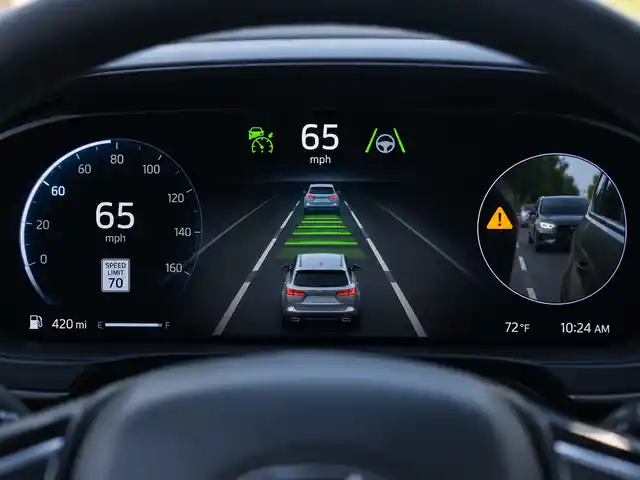
| What you may see | What it usually means |
|---|---|
| Car-ahead / distance bars | ACC has detected a vehicle ahead and is showing or controlling the selected following gap. |
| Blind-spot warning | A vehicle has been detected in or approaching the monitored side zone; many cars show this mainly in the mirror rather than the cluster. |
| Collision warning | The system has identified a rapidly increasing collision risk and may prepare or apply braking depending on the vehicle. |
| Radar blocked / unavailable | The sensor view may be obstructed, contaminated, misaligned or affected by a fault. Exact wording varies by manufacturer. |
Radar vs camera vs LiDAR
| Sensor | Strong at | Typical limitation |
|---|---|---|
| Radar | Distance and relative speed; robust operation across many weather/light conditions | Usually less visually descriptive than a camera |
| Camera | Lane markings, signs, lights and visual classification | Performance can depend more on lighting and visibility |
| LiDAR | Detailed 3D ranging and object geometry | Higher cost and different packaging/integration trade-offs |
Modern ADAS often combines sensors rather than treating one technology as a universal replacement for the others.
Radar-related ADAS in the Geely Tugella
The Geely Tugella is a useful real-world example. Geely's Saudi and global material lists adaptive/intelligent cruise control, blind-spot detection, lane-change assist and rear collision warning. Those are functions commonly associated with front and corner radar in modern ADAS architectures.
Important: Geely's public Tugella pages describe the functions but do not publish the exact radar supplier, number of radar units or operating frequency for every Saudi trim. CarGlossary therefore does not infer a specific sensor count for the Tugella.
What does a car radar sensor look like?
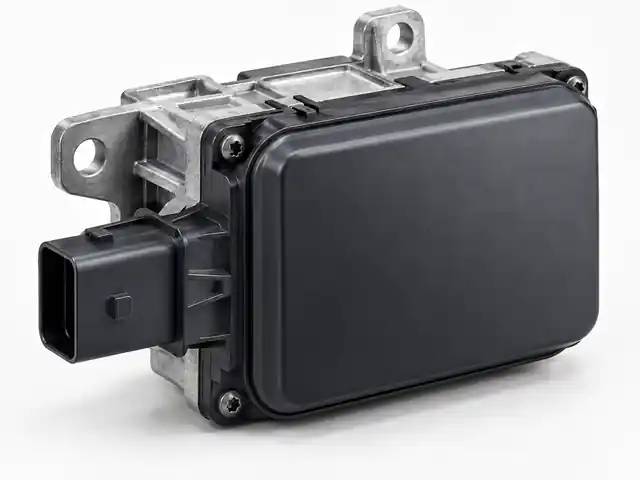
A radar module is usually a compact sealed electronic unit with a flat radar-facing surface, an electrical connector and a rigid mounting bracket. It can sit out of sight behind a bumper, grille or radar-transparent emblem. The bracket and installation angle matter because even a small positional change can alter where the sensor is “looking.”
What happens if a radar sensor is damaged?
Radar sensors can be affected by collision damage, a damaged bumper or grille, incorrect mounting, paint/material changes over the sensor area, contamination, or a shifted bracket. Replacing the electronic sensor alone may not be enough: many vehicles require ADAS calibration after sensor, bumper, suspension, alignment or collision repair.
Why does a car say “radar blocked” or “radar unavailable”?
A warning does not automatically mean the radar module has failed. Common causes include dirt, mud, snow or ice over the sensor area; a bumper cover or emblem that is damaged or incorrectly refitted; a shifted mounting bracket after a minor impact; wiring or connector faults; or a calibration/alignment issue after repair. Heavy rain or unusual environmental conditions can also temporarily limit some systems, depending on the vehicle.
Start with the owner's manual and a visual check of the manufacturer-approved sensor area. If the warning remains, a diagnostic scan can identify stored ADAS faults. Avoid sanding, drilling, adding thick paint, metallic film or accessories over a radar-transparent area unless the vehicle manufacturer explicitly permits it.
Radar is part of a safety-related driver-assistance system. Replacement parts should match the exact vehicle specification, and calibration should follow the vehicle manufacturer's repair procedure. Do not assume that a visually similar radar module is interchangeable.
What should you check when buying or repairing?
- Exact vehicle model, model year and trim.
- OEM part number and supported ADAS functions.
- Whether the sensor requires static, dynamic or combined calibration.
- Condition of the mounting bracket and bumper/radar cover.
- Whether a diagnostic scan shows related ADAS faults.
- Whether the repairer has the calibration equipment and specifications for your vehicle.