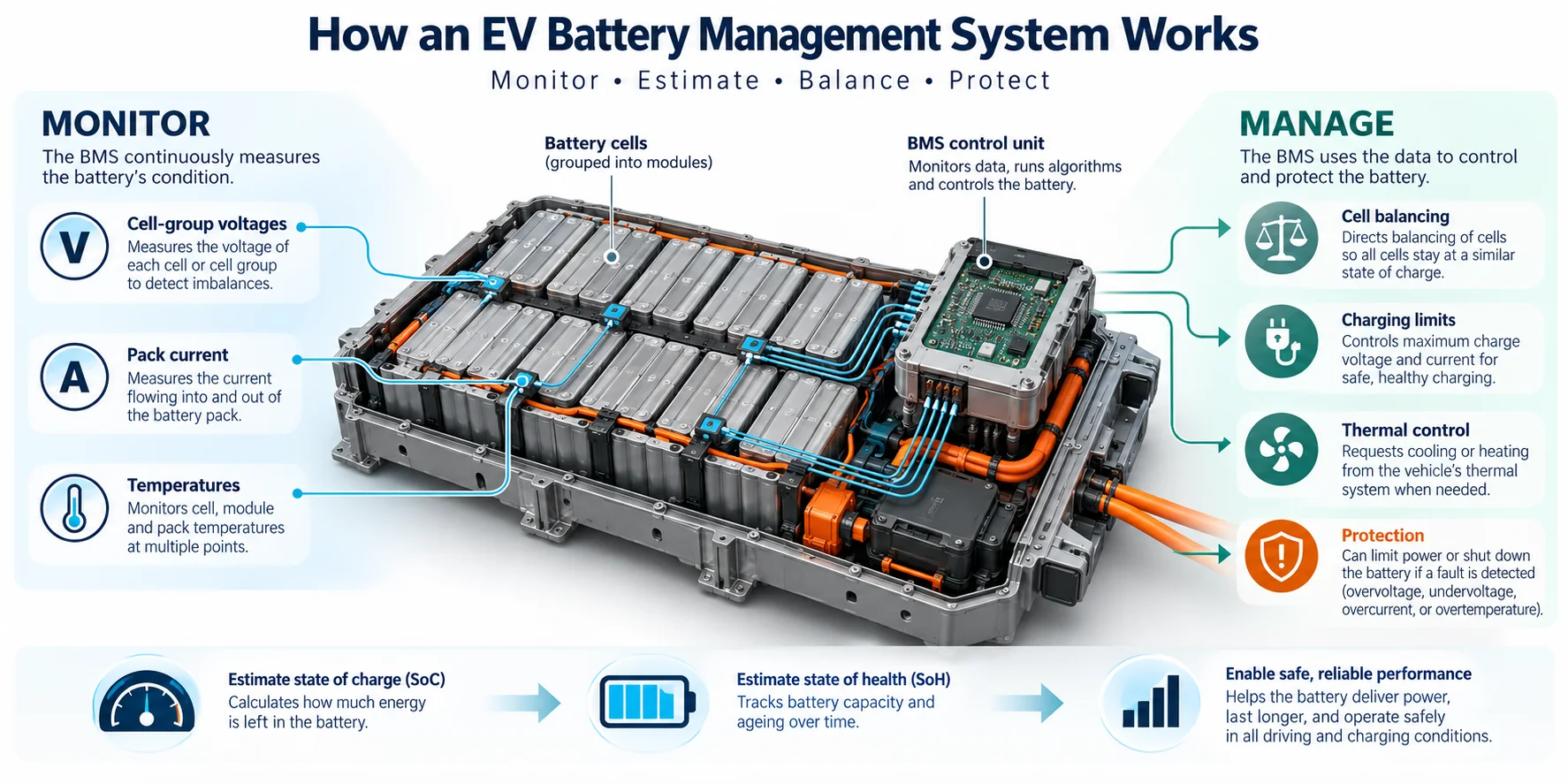
The BMS estimates battery state, watches cell voltage and temperature, manages balancing and helps decide safe limits for charging, discharging and thermal protection.
What the BMS does
The BMS is not just a battery gauge. It continuously tracks pack voltage, cell groups, current flow, temperature sensors and operating conditions. It estimates state of charge, state of health and safe operating limits.
It can request reduced power, limit charging, trigger warnings or disconnect the pack when safety limits are exceeded.
Why BMS affects charging speed
Fast charging is a negotiation between the charger, the vehicle and the battery pack. Even when the charger is powerful, the BMS can reduce requested current if the battery is too cold, too hot, too full, degraded or outside its safe window.
That is why C-rate charging, 800V architecture and battery thermal management should be understood together.
Cell balancing and usable capacity
Large EV packs contain many cells or cell groups. Small differences between them matter because the weakest cell group can limit pack operation. Balancing helps keep cells aligned so the pack can use capacity safely and consistently.
The driver usually sees the result as a smoother state-of-charge estimate, more stable range prediction and fewer battery warnings.
Buyer and owner relevance
- Explains why charging speed changes during a session.
- Helps protect battery health in hot climates.
- Controls usable battery buffers and low-charge behavior.
- Supports warranty diagnostics and fault codes.
- Works with thermal management before and during DC fast charging.
Related terms
Sources
Feature names, connector support and EV specifications can vary by model year, trim, software version and market. Always verify the exact vehicle and charging-network documentation before buying or repairing.
What is an integrated 3-in-1 battery management system?
FORVIA HELLA announced in October 2026 that it had secured series-production contracts for an integrated 3-in-1 battery-management architecture. It combines battery management, cell monitoring and high-voltage switching functions in a more integrated system, potentially reducing separate modules, cabling, weight and complexity.
This is a supplier integration approach, not a new battery chemistry or a claim that every BMS includes three identical functions. FORVIA HELLA's initial contract applications focus on hybrid vehicles; broader electric-vehicle use is a development possibility, not a confirmed specification for a particular EV.
Primary source: FORVIA HELLA official press releases, October 2026. Related: Dynamic Coordination Network electrolyte and all-solid-state batteries.