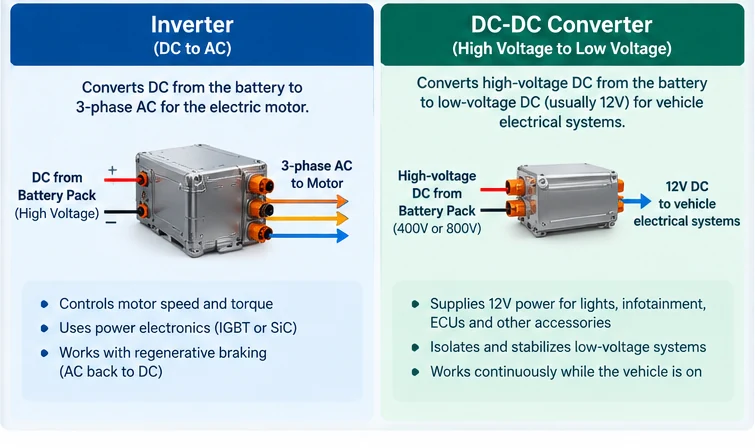
An EV traction inverter converts battery DC electricity into controlled AC electricity for a traction motor (and can manage power in reverse during regeneration). A DC/DC converter changes one DC voltage to another—for example, high-voltage battery power to the lower-voltage supply used by accessories.
The difference at a glance
| Device | Typical input | Typical output | Main job |
|---|---|---|---|
| Traction inverter | Battery DC | Controlled AC | Drive or control the AC traction motor |
| DC/DC converter | DC at one voltage | DC at a different voltage | Supply electronics or change propulsion-bus voltage |
| Onboard charger (OBC) | External AC | Battery-compatible DC | Charge the battery from AC infrastructure |
| Offboard DC fast charger | Grid electricity, often AC | Regulated high-power DC | Deliver battery charging power from external equipment |
“Converter” is a broad engineering word, and an inverter is also a type of power converter. In EV sales descriptions, the two labels often refer to the specific functions shown above.
How does a traction inverter work?
The battery normally supplies DC electricity, while many vehicle traction motors are multi-phase AC machines. Semiconductor switches inside the inverter create a carefully timed AC waveform. Its control electronics vary frequency, voltage and switching behavior to regulate motor torque and speed. The inverter may also handle energy flowing back toward the battery during regenerative braking.
Efficiency, cooling, switching design and software all matter. Silicon carbide (SiC) devices are one approach used by some vehicles, but “SiC” alone does not guarantee an objectively faster or more efficient car: evaluate the complete system and actual test conditions.
What does the DC/DC converter do?
Most EVs contain lower-voltage equipment—lighting, infotainment, control modules and other accessories—that cannot run directly on the main high-voltage traction bus. A step-down DC/DC converter supplies this lower-voltage system and can maintain the auxiliary battery. Other boost converters can increase voltage for propulsion or charging functions, depending on the design.
Where do the components sit?
Driving path. A separate DC/DC branch supplies lower-voltage vehicle systems; the flow is simplified, not a wiring diagram.
Where does the onboard charger fit?
When using a home or destination AC charging point, the onboard charger converts incoming AC to regulated DC to charge the traction pack. Its maximum AC rating can limit charging speed. At a DC fast charger, the station performs the main grid-to-DC conversion, so the vehicle's conventional AC onboard charger is not the bottleneck for DC charging.
For a fuller explanation of station rating versus vehicle acceptance, see charger power vs car power. Some integrated power-electronics architectures combine inverter, charger and converter functions to reduce components, weight or space. However, integration changes the design and does not mean every component is interchangeable.
Common misconceptions
- “An inverter charges the battery from an AC wall plug.” Normally that is the onboard charger's role, although integrated or bidirectional designs may share hardware.
- “A DC/DC converter always reduces voltage.” Many are step-down converters, but step-up (boost) converters also exist.
- “A large inverter automatically means faster charging.” Charging depends on battery acceptance, charging equipment, thermal control and design limits.
- “Bidirectional charging is included by default.” It needs compatible vehicle hardware, software, equipment and market support.
Why should buyers care?
Buyers rarely need to choose an inverter directly. But understanding these differences prevents confusion when comparing AC charger ratings, 400V vs 800V architectures, motor power and V2L/V2G claims. Repair work on inverters, converters, power electronics and the high-voltage battery requires specialist qualifications.
Continue learning
Primary sources
- U.S. DOE — Power electronics research and development
- U.S. DOE — Electric drive systems research and development
- U.S. DOE AFDC — How all-electric cars work
Powertrain design, usable battery capacity, charging behavior and repair procedures vary by vehicle model, year, trim and market. Always check official documentation.