A battery electric car stores electricity in a high-voltage battery and uses an electric motor to turn its wheels. Power electronics control the motor, while battery-management, charging and cooling systems keep the vehicle operating safely and efficiently.
How electricity moves through an EV
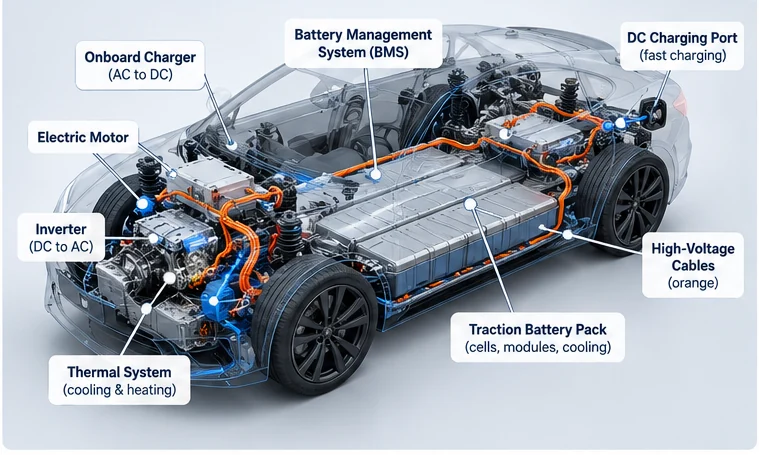
In a typical battery electric vehicle (BEV), the traction battery stores direct-current (DC) electrical energy. A power inverter adjusts that electricity to drive an electric traction motor. A reduction gear or drive unit transmits the motor's torque to the wheels. The layout can vary: some vehicles have one motor and others have two or more.
Simplified energy path during acceleration. It omits wiring, contactors, fuses, gearing, motor controllers and other safety equipment.
The six systems you should recognize
- Traction battery pack: holds energy, usually expressed in kilowatt-hours (kWh).
- Electric drive motor: produces the torque that moves the vehicle; some motors also act as generators while braking.
- Inverter and power electronics: manage motor speed and torque. A DC/DC converter supplies lower-voltage vehicle systems.
- Battery management system (BMS): monitors cells, temperatures, current and limits to protect the pack.
- Thermal management: heats or cools the battery, motor and electronics within operating limits.
- Charging system: accepts power through the charging port; the onboard charger converts AC electricity to DC when needed.
How does charging work?
With AC charging, the vehicle's onboard charger converts incoming AC into DC for the battery. With DC fast charging, conversion largely happens in the external charging station, and regulated DC power is delivered to the vehicle through the charging interface. Charging speed depends on both the station and what the battery can accept at that moment, not just a maximum kW label.
How does regenerative braking work?
During deceleration, the traction motor can work as a generator, recovering some of the moving vehicle's energy and sending it toward the battery. Regeneration does not recover all braking energy, and friction brakes remain essential, particularly for emergency stops and certain road or battery conditions. Read our regenerative braking explanation.
What actually determines driving range?
Battery capacity and energy consumption work together. For example, an illustrative usable battery of 60 kWh at an average of 18 kWh per 100 km would suggest roughly 333 km before accounting for safety reserves, changing conditions and additional losses. This is a calculation, not a specification or promise for any real model.
Highway speed, wind, weather, tire choice, hills, cabin heating and driving style can change consumption substantially. Use comparable test cycles—EPA, WLTP or CLTC—before comparing manufacturer claims from different markets.
How is a BEV different from a gasoline car?
| System | Battery electric car | Gasoline car |
|---|---|---|
| Onboard energy | Electricity stored in a traction battery | Liquid fuel in a tank |
| Main propulsion | Electric motor(s) | Internal combustion engine |
| Refueling | AC or DC charging | Fuel pump |
| Local tailpipe exhaust | No exhaust while driving | Combustion exhaust |
| Slowing down | Often blends regenerative and friction braking | Primarily friction braking |
What should owners avoid assuming?
High-voltage equipment is not intended for do-it-yourself service. Electrical isolation, cooling, protective contactors and crash-response systems differ by manufacturer. Range, charging time, battery size and motor output must be verified for the specific model year, trim and market.
Continue learning
Primary sources
- U.S. DOE AFDC — How all-electric cars work
- U.S. DOE — Power electronics research and development
- U.S. DOE AFDC — All-electric vehicle basics
Battery, drive-system and charging details vary by model, year, trim and country. Manufacturer terms and claimed performance are not universal specifications.