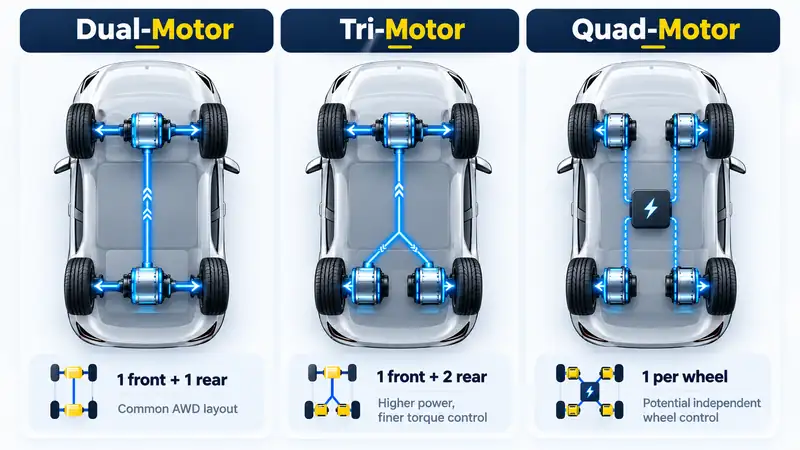
Dual-motor usually means one motor per axle. Tri-motor commonly means one motor on one axle and two on the other. Quad-motor can allow one motor per wheel. These are common layouts, not mandatory rules.
At a glance
| Dual-Motor | Tri-Motor | Quad-Motor | |
|---|---|---|---|
| Typical layout | 1 front + 1 rear | 1 on one axle + 2 on the other | Often 1 per wheel |
| AWD | Common | Common | Common |
| Left/right torque control | Usually limited by axle hardware | Can be very precise on the twin-motor axle | Potentially independent at all four wheels |
| Hardware complexity | Moderate | Higher | Highest |
| Weight/cost pressure | Lower | Higher | Highest |
Dual-motor
A common electric AWD layout places one motor on the front axle and one on the rear. Volkswagen describes dual-motor EVs this way. It is a relatively simple way to add AWD, stronger acceleration and flexible front/rear power distribution.
Tri-motor
A tri-motor layout adds a third motor. Volkswagen describes a common arrangement as one front motor and two separate rear motors. Lucid Air Sapphire uses that configuration, while CEER confirms EXOBOT uses Tri-Motor AWD but has not publicly detailed the exact front/rear distribution.
Quad-motor
Four motors can allow a manufacturer to control each wheel's drive torque independently. That can support advanced off-road traction or very precise torque vectoring. The trade-off is more motors, inverters, cooling, wiring, control software and mass.
Does more motors mean faster?
Not automatically. Total performance depends on battery power, inverter limits, motor design, gearing, thermal limits, tire grip and software. A well-engineered dual-motor car can outperform a heavier or less powerful tri- or quad-motor vehicle.
What about efficiency and range?
Extra motors can add weight and losses, but modern EVs may reduce the penalty by operating only the most efficient motor at light load or disconnecting an axle when full AWD is unnecessary. The exact strategy is manufacturer-specific.
Examples
- CEER EXOBOT: Tri-Motor AWD, up to 850 hp.
- Lucid Air Sapphire: one front motor plus twin rear motors with torque vectoring.
- Typical dual-motor EV: one motor on each axle.
What should buyers care about?
Look beyond the number on the badge. Compare actual acceleration, range, charging, traction, towing or off-road requirements, thermal performance and the vehicle's intended use. Motor count is an architecture choice, not a quality score.