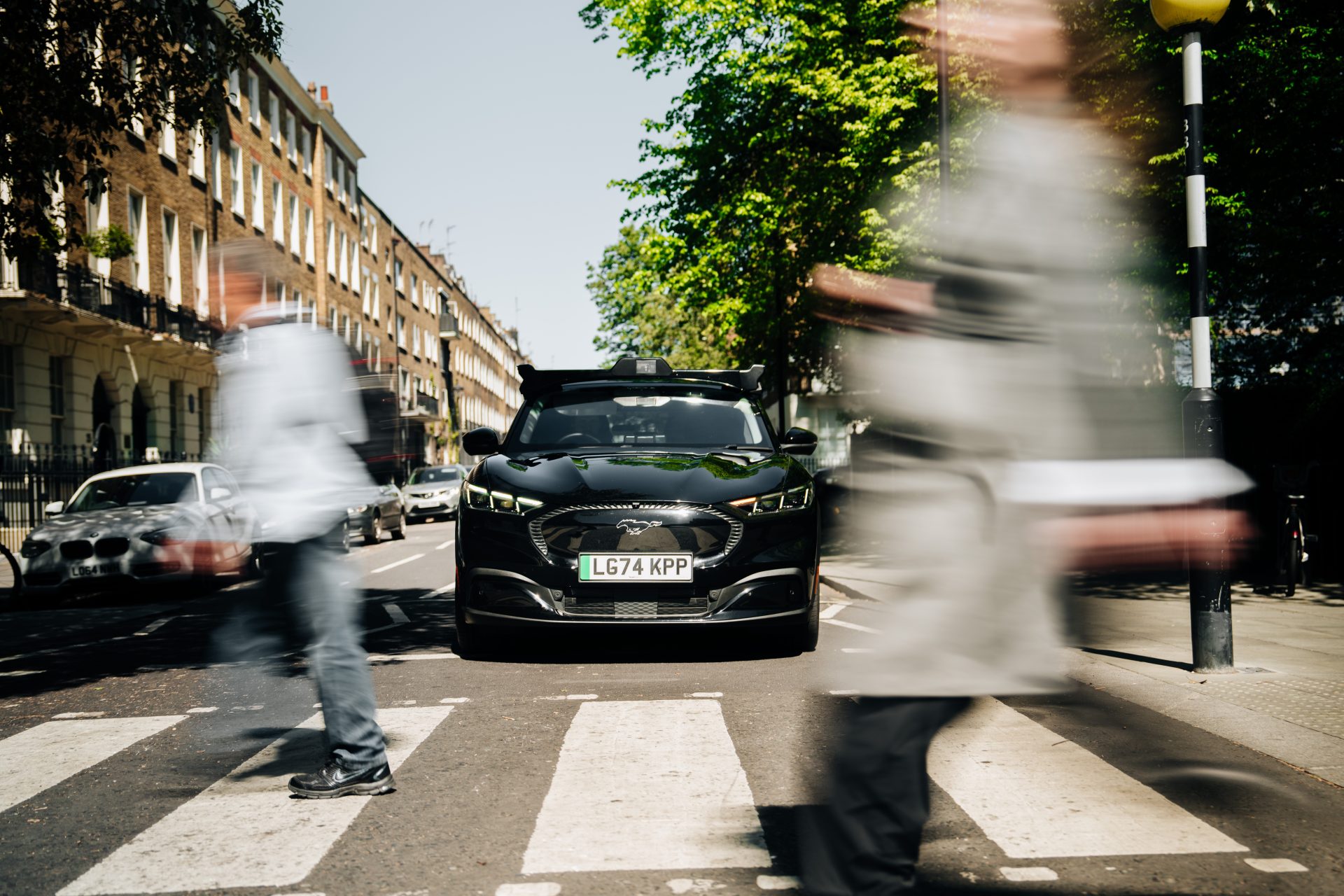
Supervised autonomous riding means the automated system is doing the driving during the trip, while a trained human safety driver remains onboard to oversee operation and intervene if required. It is a deployment stage, not a synonym for “driverless.”
How the London Wayve + Uber service works
Starting September 3, Londoners requesting UberX, Uber Electric or Uber Comfort can be matched with a Wayve vehicle at no extra charge. The vehicle is an all-electric Ford Mustang Mach-E fitted with the Wayve AI Driver and surround sensors.
Riders can accept the Wayve vehicle or switch to a conventional ride before arrival. The vehicle can be unlocked and the trip started through the Uber app. An in-car display shows the planned path and supports 64 languages. At launch, Wayve says trips can operate across London except airports, with a small fleet expanding gradually.
What does the safety driver actually do?
Wayve describes the initial phase as supervised autonomous rides. A trained, Transport for London-licensed private-hire driver is onboard to oversee the trip. The safety driver is there as a human fallback during this deployment stage: monitoring the automated system and the road situation, remaining ready to take control when necessary, and supporting safe testing and operation while the service scales.
This human role is important. A passenger may experience the car steering, accelerating and braking automatically, but the presence of an onboard safety driver means the service should not be described as a fully driverless public robotaxi operation.
How is this different from Level 4?
| Wayve London launch | Driverless Level 4 service | |
|---|---|---|
| Human onboard? | Yes — trained safety driver | A human driver is not required within the approved operating domain |
| Human fallback role? | Human can oversee and intervene | The automated driving system must handle the driving task and fallback within its operational design domain |
| Passenger experience | Automated ride with supervision | Passenger-only ride can be possible |
| Where it operates | London launch area, excluding airports | Only inside the specific Level 4 operational design domain |
SAE automation levels describe the driving automation feature and the roles of the system and human user. They are not simply a label for how futuristic a vehicle feels. NHTSA’s consumer explanation of Level 4 says the system is responsible for all driving tasks within a limited service area and a human driver is not needed to operate the vehicle there.
What is Wayve AI Driver?
Wayve calls its approach AV2.0: an end-to-end AI driving system trained from driving experience rather than depending on a traditional stack dominated by hand-coded rules and high-definition maps. The London launch is significant because it puts that approach into a real passenger service rather than keeping it only in development fleets.
However, end-to-end autonomous-driving architecture does not automatically determine an SAE automation level. The same underlying AI approach can be deployed with different supervision, fallback and regulatory arrangements.
Why the Mercedes-Benz agreement matters
On September 22, Wayve and Mercedes-Benz announced a production agreement to integrate Wayve AI Driver into future Mercedes-Benz vehicles, targeting advanced urban and highway point-to-point driving assistance starting in the next two years. This is a useful contrast with the Uber pilot: one is a supervised ride-hailing deployment; the other is a planned production-vehicle assistance program.
Why this matters for buyers
“Autonomous,” “self-driving,” “supervised,” “hands-off,” “eyes-off” and “driverless” are often mixed together in headlines. Buyers should instead ask three questions: Who is responsible for monitoring the road? Who performs fallback when something goes wrong? Where is the feature allowed to operate?
Related CarGlossary terms
Sources
- Wayve — Wayve and Uber launch autonomous rides in London, September 3, 2026
- Wayve — Mercedes-Benz production agreement, September 22, 2026
- NHTSA — Automated Vehicle Safety and automation levels
CarGlossary uses “driverless Level 4” only when the system can operate without a human driver within its defined operational design domain. A supervised public ride is not presented as equivalent to that.