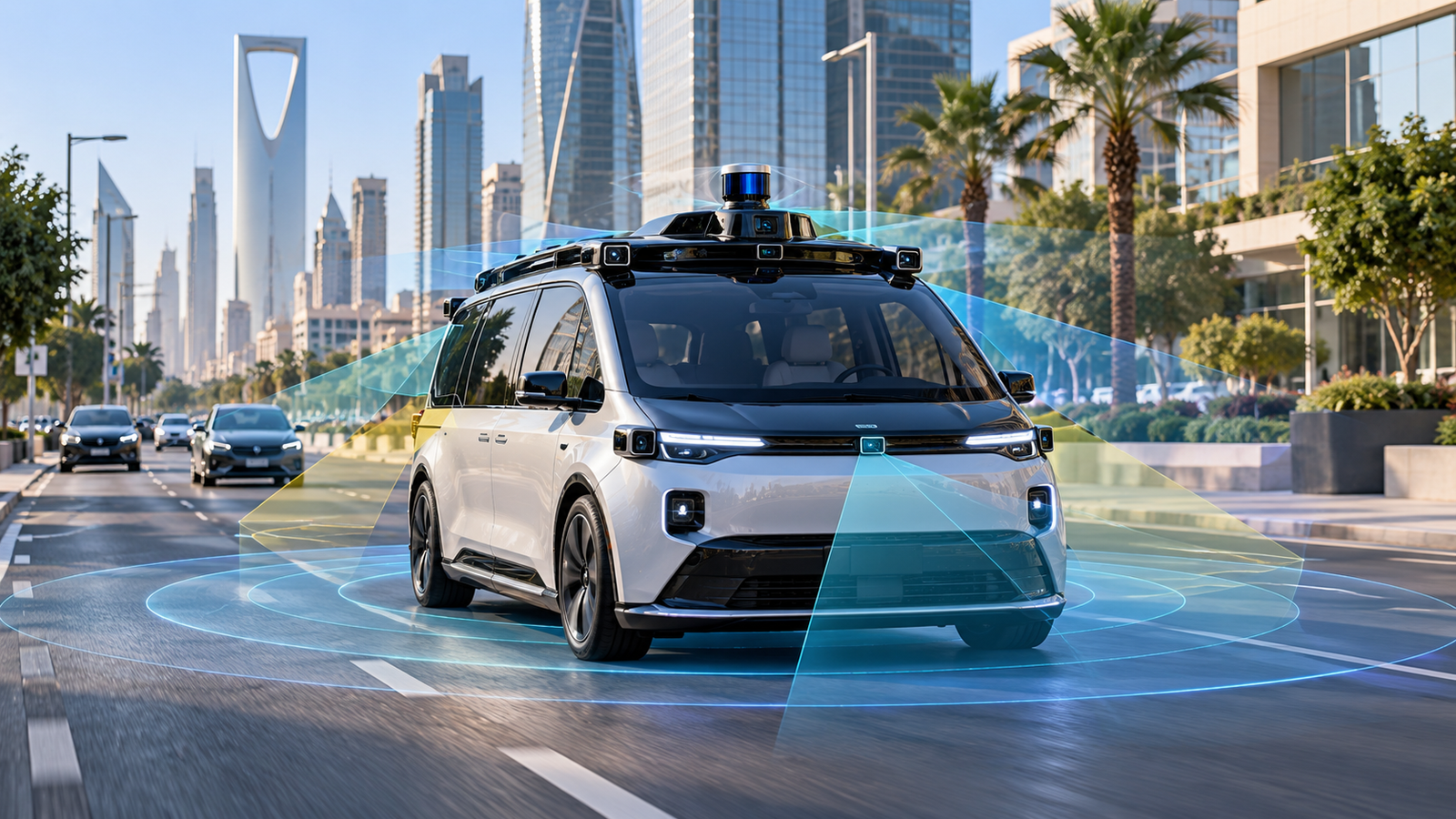
Level 4 = the system drives, monitors the environment and handles fallback within its defined operating domain. A human driver is not required to take over there. Level 4 does not mean the vehicle can drive everywhere or in every condition.
If a human must continuously watch the road, it is not unsupervised Level 4 operation. If the automated driving system can safely handle the driving task and fallback by itself inside its ODD, it can qualify as Level 4.
Autonomous driving Levels 0–5
| Level | What it means | Human role |
|---|---|---|
| Level 0 | No driving automation | Human performs the driving task |
| Level 1 | Steering or speed assistance | Human drives and monitors |
| Level 2 | Steering and speed assistance together | Human remains responsible and monitors continuously |
| Level 3 | Conditional automated driving | System drives while engaged, but can require a human takeover |
| Level 4 | High driving automation | System drives and handles fallback inside its operational design domain |
| Level 5 | Full driving automation | System can drive under all roadway and environmental conditions that a human driver could handle |
For the complete framework, see SAE driving automation Levels 0–5.
What limits a Level 4 vehicle?
The main limitation is its operational design domain (ODD). The ODD defines where and under what conditions the automated driving system is intended to operate. It can include a geographic zone, road type, speed range, weather limits, lighting conditions or other restrictions.
This is why a Level 4 robotaxi can be genuinely driverless in one mapped service area yet be unable or unauthorized to operate outside it. Level 4 is therefore not the same as “a car that can autonomously drive anywhere.”
Level 3 vs Level 4
The critical difference is fallback. At Level 3, a human fallback-ready user may be expected to take over when the automated system requests it. At Level 4, the automated driving system must be able to achieve a minimal-risk condition or otherwise handle fallback itself within its ODD. The human passenger is not the required backup driver.
Level 2 vs Level 4
At Level 2, the system may control steering, braking and acceleration at the same time, but the human driver still performs the supervisory role and remains responsible for the driving task. A Level 2 system can feel highly automated without being autonomous in the Level 4 sense.
Level 4 vs Level 5
Level 4 can be restricted by geography or operating conditions. Level 5 is the theoretical highest automation level: the automated driving system can operate everywhere a human driver could reasonably drive, without being limited to a specific ODD. Current robotaxi deployments generally focus on Level 4 rather than Level 5.
Why are robotaxis associated with Level 4?
A robotaxi can be deployed inside a controlled service area instead of needing to solve every possible driving environment. That makes Level 4 a practical target: the operator can define an ODD, map or validate the service area, monitor the fleet and expand coverage gradually.
Compatible V2X (vehicle-to-everything) systems can provide additional road-hazard information to equipped automated vehicles, but V2X is not a requirement for SAE Level 4 classification.
However, a company can be developing a Level 4 system while still operating passenger tests with a trained human onboard. That testing arrangement is better described as supervised autonomous driving until the service is actually operating without a required human driver.
Current examples and deployment context
CarGlossary tracks several useful examples. Momenta's UAE robotaxi project is being developed around Level 4 capability. Wayve and Uber's London passenger service uses trained drivers during its supervised rollout. MOIA and Beep's ID. Buzz program in Orlando uses vehicles designed for Level 4 operation while trained human operators remain onboard during the current passenger testing phase.
Level 4 capability vs deployment status
A system can be engineered for Level 4 while its current public-road program is still supervised. CarGlossary separates four statuses: testing, supervised operation, commercial service, and fully driverless Level 4 operation within the stated ODD. A safety observer who never intervenes is useful validation evidence, but the service is not driverless while that human is still required onboard.
Kodiak AI provides a current example outside passenger robotaxis. Its Dallas–Houston long-haul program remains in pre-launch validation while the company completes its autonomous-vehicle safety case. By contrast, Kodiak-powered industrial trucks in the Permian Basin already operate commercially without humans in the cab. The same automation technology can therefore have different deployment statuses in different operational domains.
Common questions
Does Level 4 require a steering wheel?
Not necessarily. Level 4 describes who performs the driving task and fallback, not whether the vehicle must physically have a steering wheel. Vehicle design and local regulations can still require or permit manual controls.
Can a Level 4 car drive anywhere?
No. It can operate autonomously only within its defined operational design domain.
Can you sleep in a Level 4 vehicle?
From an automation-role perspective, an occupant is not required to supervise the driving task while the Level 4 feature is operating inside its ODD. Actual passenger behavior remains subject to the vehicle design, operator rules and local law.
Is a safety driver still Level 4?
A vehicle or automated driving system may be designed for Level 4 while being tested with a safety driver. But a service that operationally requires that human to supervise and take over should not be described as an unsupervised driverless Level 4 service.