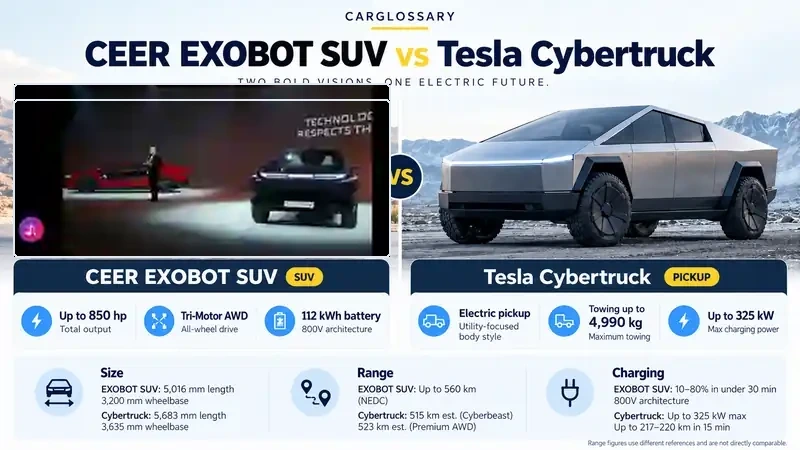
EXOBOT SUV is shorter, uses an official 112 kWh battery and Tri-Motor AWD with 850 hp, and targets premium SUV buyers. Cybertruck is much longer and adds a pickup bed, very high towing capacity and substantially more published cargo volume.
Key specifications
| Specification | CEER EXOBOT SUV | Tesla Cybertruck Cyberbeast | Tesla Cybertruck Premium AWD |
|---|---|---|---|
| Body type | Large electric SUV | Electric utility pickup | Electric utility pickup |
| Length | 5,016 mm | 5,682.9 mm | 5,682.9 mm |
| Width | 2,101 mm | 2,031.6 mm body width excluding mirrors* | 2,031.6 mm body width excluding mirrors* |
| Height | 1,693 mm | About 1,791 mm on Tesla spec page | About 1,791 mm on Tesla spec page |
| Wheelbase | 3,200 mm | 3,635 mm | 3,635 mm |
| Ground clearance | 280 mm; up to 300 mm with active air suspension | Up to 406 mm in Extract Mode | Up to 406 mm in Extract Mode |
| 0–100 km/h | 2.9 s | 2.7 s** | 4.3 s |
| Drive | Tri-Motor AWD | AWD | AWD |
| Maximum power | 625 kW / 850 hp | Tesla Saudi page does not publish hp | Tesla Saudi page does not publish hp |
| Battery | 112 kWh NCM | Tesla Saudi spec page does not list pack capacity | Same |
| Published range | Up to 560 km NEDC | 515 km estimated | 523 km estimated |
| Charging | 10–80% DC in under 30 min; 800V architecture | 325 kW max; up to 217 km added in 15 min | 325 kW max; up to 220 km added in 15 min |
| Cargo | 402 L trunk | 3,423.5 L published cargo figure | 3,423.5 L published cargo figure |
| Towing | Not published on CEER SUV product page | 4,990 kg | 4,990 kg |
| Seats | CEER product page does not state seat count | 5 | 5 |
*Tesla's owner's manual lists 2,031.6 mm excluding mirrors, while the Saudi Cybertruck page prominently shows 2,200.7 mm with mirrors folded. **Tesla states Cyberbeast's 2.7-second figure with rollout subtracted. Range figures are not directly comparable: CEER publishes NEDC, while Tesla labels its Saudi-page figures as estimates and notes that U.S. specs are shown.
Which one is bigger?
Cybertruck is about 667 mm longer and has a wheelbase about 435 mm longer than EXOBOT SUV. EXOBOT's body is slightly wider when Tesla's mirror-excluded width is used, but Cybertruck becomes much wider once its mirrors are included. The shapes serve different purposes: CEER packages a large passenger SUV, while Tesla devotes significant length to a 6-foot pickup bed and utility storage.
Performance and drivetrain
EXOBOT SUV's official launch configuration uses three motors, AWD, up to 850 hp and a claimed 2.9-second 0–100 km/h time. CEER also says its torque-vectoring and chassis systems operate continuously.
Cyberbeast is slightly quicker on Tesla's published 0–100 km/h figure at 2.7 seconds, while Premium AWD is substantially slower at 4.3 seconds. Tesla's Saudi page does not publish horsepower, so we do not substitute a third-party power figure.
Range: do not compare the headline numbers directly
EXOBOT SUV is listed at up to 560 km NEDC. Tesla lists 515 km for Cyberbeast and 523 km for Premium AWD on its Saudi page, but also states that U.S. specifications are shown. NEDC and Tesla's published estimate are different test references, so the numbers should not be treated as an apples-to-apples range contest.
Charging
CEER publishes a 112 kWh battery, 800V architecture and a 10–80% DC charging time of under 30 minutes. Tesla publishes a 325 kW Supercharging maximum for Cybertruck and quotes up to 217–220 km of range added in 15 minutes depending on trim. Because the companies publish different charging metrics, a direct charging-time winner cannot be established from the official figures alone.
SUV practicality vs pickup utility
This is where the vehicles diverge most. EXOBOT SUV has a 402 L enclosed trunk and an adjustable air suspension with up to 300 mm ground clearance. Cybertruck is engineered around utility: Tesla publishes 3,423.5 L of cargo capacity, a 6'×4' bed, a maximum payload of 1,134 kg, towing up to 4,990 kg and up to 406 mm ground clearance in Extract Mode.
Interior and technology
EXOBOT SUV emphasizes a panoramic digital cabin: CEER lists a pillar-to-pillar 48-inch curved “Digital Horizon” display with 8K resolution, premium materials, climate filtration, ambient lighting and its SoundStage audio system. Cybertruck uses an 18.5-inch center touchscreen plus a 9.4-inch rear touchscreen and prioritizes a minimalist utility-focused cabin.
Warranty and Saudi-market status
| EXOBOT First Edition | Cybertruck | |
|---|---|---|
| Vehicle warranty | 6 years / 200,000 km in CEER First Edition Companion Package | 4 years / 80,000 km |
| Battery warranty | 8 years / 200,000 km | 8 years / 240,000 km battery & drive unit |
| Saudi availability | CEER lists First Edition and PLUS as available soon | Tesla Saudi page currently says “Get Updates” and displays U.S. specs |
| Official Saudi price | Not yet published | No Saudi price displayed on the Cybertruck page checked |
Which buyer does each vehicle suit?
They overlap in futuristic design and high-performance EV positioning, but their practical missions are different. The meaningful choice depends on whether the buyer wants a luxury/performance SUV or an electric utility pickup.