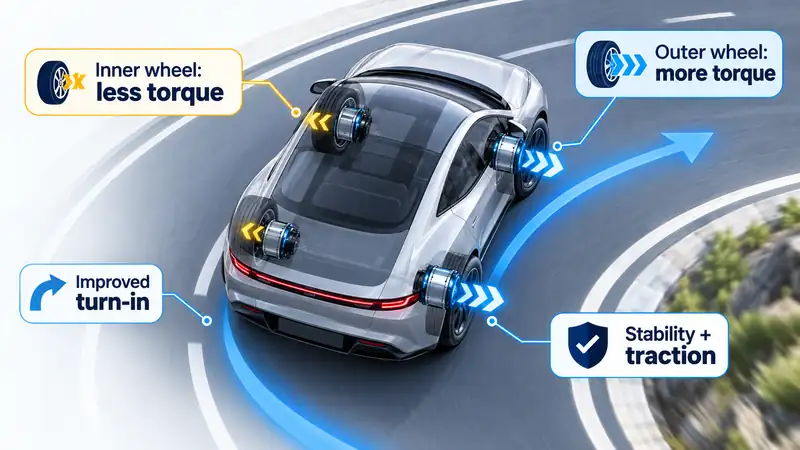
Torque vectoring actively redistributes driving force across the vehicle. In an EV, independently controlled motors can make this especially fast because software can command motor torque directly.
How does torque vectoring work?
When a car turns, the outside wheels travel farther than the inside wheels. A torque-vectoring system can increase or reduce torque at selected wheels to help the vehicle follow the driver's intended path. Depending on the system, it may help rotate the car into a corner, reduce understeer, improve traction on a slippery surface or stabilize the car at high speed.
Three common ways to create torque vectoring
- Brake-based: the stability-control system lightly brakes an inside wheel so more useful drive force reaches the wheel with better traction. It is relatively inexpensive but converts some energy into heat.
- Active differential: clutches or gears vary torque mechanically between the left and right wheels on an axle.
- Independent electric motors: separate motors can change torque electronically and very quickly. This is especially useful in tri-motor and quad-motor EV layouts.
Why EVs make torque vectoring interesting
Electric motors can change torque extremely quickly and can also provide regenerative braking. With two independently controlled motors on one axle, the system may add drive torque to the outside wheel while reducing or even regeneratively braking the inside wheel. That gives engineers another tool for controlling yaw and cornering balance.
Lucid describes this explicitly on the Air Sapphire: its twin rear-drive unit can provide different, and even opposing, torque at the rear wheels to promote turn-in or straight-line stability.
Torque vectoring in CEER EXOBOT
CEER says EXOBOT uses a tri-motor AWD architecture and that advanced torque vectoring and chassis systems operate continuously to support stability, agility and confidence. CEER has not publicly detailed the exact wheel-by-wheel control strategy, so CarGlossary does not assume the same hardware layout as Lucid or another tri-motor vehicle.
See the full CEER EXOBOT specifications.
What are the benefits?
- Better traction when grip differs between wheels.
- Reduced understeer or improved turn-in.
- More stable acceleration out of corners.
- Better integration between powertrain, stability control and chassis systems.
- In EVs, some torque control can be achieved without relying only on friction brakes.
What torque vectoring does not guarantee
A car having “torque vectoring” does not automatically mean it will handle better than every car without it. Tires, suspension geometry, steering, weight distribution, software tuning and road conditions still matter. Manufacturers also use the term for systems with very different levels of capability.