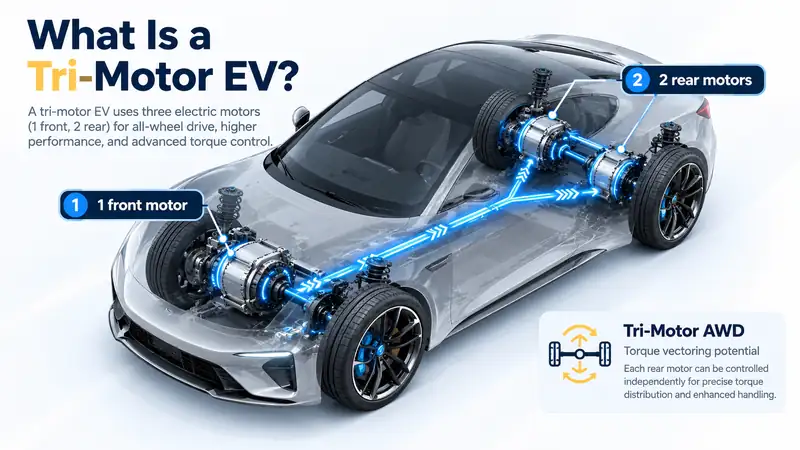
Tri-motor means the vehicle has three propulsion motors. It does not mean three driven wheels. The exact motor layout depends on the manufacturer.
Tri-motor vs tri-wheel: they are not the same thing
This is an easy term to misread. Tri-motor describes the number of propulsion motors: three. Tri-wheel or three-wheel vehicle describes the number of wheels: three. A normal four-wheel car can therefore be tri-motor.
For example, CEER EXOBOT is a four-wheel vehicle with a tri-motor AWD powertrain. If you searched for “tri-wheel” after seeing “Tri-Motor AWD” in a specification sheet, the motor count — not the wheel count — is what the manufacturer means.
How does a tri-motor EV work?
An electric motor can be assigned to an axle or, in some layouts, to an individual wheel. With three motors, a manufacturer can combine one motor on one axle with two motors on the other axle. That can make it possible to control left-right torque on the two-motor axle more precisely.
There is no single universal tri-motor layout. For example, Lucid's Air Sapphire uses one motor at the front and a twin-motor rear drive unit. CEER officially describes EXOBOT as using a tri-motor all-wheel-drive architecture, but its public product page does not currently specify the exact front/rear motor distribution.
Why use three motors instead of two?
- More power: adding another motor can raise total available output when the battery and inverter system can support it.
- More precise torque control: two independently controlled motors on one axle can vary torque between the left and right sides more directly.
- Traction: tri-motor layouts are typically AWD, helping distribute power across both axles.
- Performance tuning: software can use the extra motor to influence acceleration, cornering balance and stability.
What is torque vectoring?
Torque vectoring means changing how much driving torque reaches different wheels to help the vehicle turn, accelerate or remain stable. A tri-motor system can make this especially useful when two motors independently control the left and right wheels on the same axle.
But three motors do not automatically guarantee advanced torque vectoring. The result depends on the mechanical layout, inverters, control software, sensors and how the manufacturer programs the system.
Single vs dual vs tri vs quad motor
| Layout | Typical arrangement | Why manufacturers use it |
|---|---|---|
| Single motor | One driven axle | Lower cost, lower weight and good efficiency |
| Dual motor | One motor front + one rear | AWD, stronger acceleration and flexible efficiency |
| Tri-motor | One motor on one axle + two on the other | Higher performance and potentially finer left-right torque control |
| Quad motor | Often one motor per wheel | Very fine independent wheel-torque control and extreme performance/capability |
Note: these are common layouts, not mandatory definitions. Manufacturers can package motors differently.
Advantages of a tri-motor EV
- Very high power potential.
- Strong AWD traction.
- Faster and more precise torque distribution.
- Potential for sophisticated torque-vectoring strategies.
- Can improve high-performance handling without needing a mechanical differential to do all of the torque distribution.
Disadvantages and trade-offs
- Cost: a third motor, inverter hardware and cooling add expense.
- Weight: more propulsion hardware usually adds mass.
- Complexity: thermal management, software calibration and packaging become more demanding.
- Efficiency: extra hardware can create losses or weight penalties, although manufacturers can reduce this with efficient motor control or disconnect strategies.
So a tri-motor badge does not automatically mean a better EV for every buyer. It is most useful when a manufacturer wants exceptional performance, traction or torque control.
CEER EXOBOT tri-motor AWD
CEER officially lists Tri-Motor AWD with up to 850 hp for EXOBOT. The sedan is listed at 0–100 km/h in 2.6 seconds and the SUV at 2.9 seconds, alongside a 112 kWh NCM battery and 800V electrical architecture. CEER also says the tri-motor AWD configuration is used for power distribution and works with the vehicle's chassis systems.
See the full CEER EXOBOT price, specifications, interior and gallery.
Examples of tri-motor EVs
- CEER EXOBOT: official tri-motor AWD architecture, up to 850 hp.
- Lucid Air Sapphire: one front motor plus a twin-motor rear drive unit, with independent rear torque control.
Related terms
Sources
- CEER — EXOBOT: tri-motor AWD architecture
- CEER — EXOBOT Sedan: Tri-Motor AWD, up to 850 hp
- Lucid Motors — Air Sapphire three-motor powertrain and torque vectoring
- Volkswagen UK — electric motors explained, including single-, dual- and tri-motor layouts
- Rivian — R1 Tri-Motor, one front motor and two rear motors
Motor count is only one part of EV performance. Battery output, inverter capacity, cooling, gearing, tires, chassis tuning and control software determine how well the system actually performs.