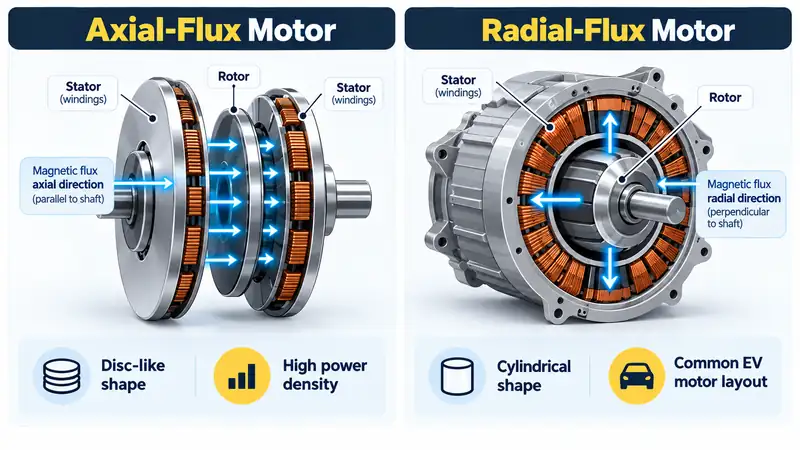
Axial flux describes the direction of magnetic flux through the motor. It is a motor topology, not a motor-count term. A car can be single-, dual- or tri-motor and still use radial-flux or axial-flux motors.
Axial-flux vs radial-flux
| Axial-flux | Radial-flux | |
|---|---|---|
| Flux direction | Mostly parallel to shaft | Mostly outward/inward across the radius |
| Typical shape | Short, wide, disc-like | Longer cylindrical package |
| Industry maturity | Growing in high-performance applications | Dominant EV motor architecture today |
| Key appeal | High torque/power density and compact axial length | Established manufacturing and broad scalability |
Why are axial-flux motors attracting attention?
YASA, a Mercedes-Benz subsidiary specializing in axial-flux motors, highlights high torque density, high power density and a much shorter axial package as major advantages. That can give vehicle engineers more freedom for packaging and performance.
Potential advantages
- High torque density.
- High power density.
- Short axial length can save packaging space.
- Lower mass is possible for a given performance target.
- Useful for high-performance EV and hybrid applications.
Challenges and trade-offs
Axial-flux motors are not automatically superior in every application. Manufacturing cost, cooling, mechanical tolerances, rotor forces, magnet supply, production volume and integration with the inverter and gearbox all matter. Radial-flux motors remain extremely mature and widely manufactured.
Axial flux is not the same as tri-motor
Tri-motor tells you how many motors the vehicle uses. Axial flux tells you how a motor is built. A three-motor car could use three radial-flux motors, three axial-flux motors, or a mixed arrangement if the manufacturer designed it that way.
CEER has confirmed EXOBOT's Tri-Motor AWD layout, but CEER has not publicly identified EXOBOT's traction motors as axial-flux. CarGlossary therefore does not make that assumption.
Where is axial-flux used?
YASA supplies and develops axial-flux technology for performance automotive applications and is part of Mercedes-Benz. The technology is increasingly discussed for future high-performance EVs because of its compact size and power density.