Outside wheels travel farther during a turn. A differential allows the speed difference; a lock temporarily prevents it. It adds traction capability, not engine power, and cannot create grip if every tyre is sliding.
How a diff lock works
Same rut, same car — what does the lock change?
Simplified rear view: wheel 1 hangs over a rut; wheel 2 rests on firm ground.
Before locking: open differential
Result: the car can remain stuck.
After locking: wheels coupled
Result: the car can move if there is enough grip.
What changed? The lock forces equal wheel speeds, so the suspended wheel no longer limits useful torque in the same way. This illustrates one axle lock, not a guaranteed equal torque split.
Picture one rear wheel hanging over a rut while the other grips solid ground. A rear locker lets the grounded wheel help move the car. Locking fixes relative speed, not a permanent 50/50 torque split.
Front, rear and centre locks
| Location | What it connects | Practical difference |
|---|---|---|
| Rear | Left and right rear wheels | Helps with unequal rear-wheel grip; turning can become harder. |
| Front | Left and right front wheels | Can strongly affect steering; follow the vehicle’s operating limits. |
| Centre / center | Front and rear driveline outputs | Applies where a centre differential exists; it does not lock every left/right wheel pair. |
Low range changes gearing for slow driving; it is not a diff lock. Some part-time four-wheel-drive systems couple the axles through a transfer case without a centre differential.
Selectable lockers: electric or air-operated
You request engagement with a switch or lever. The actuator may be electrical or pneumatic; the engaged mechanism still mechanically couples the outputs.
Automatic lockers
Engage and release according to their design and driving conditions. They do not necessarily use the same driver procedure as a selectable locker.
Is a limited-slip differential (LSD) a locker?
No. An LSD limits slip and can bias more torque toward the gripping wheel while allowing different wheel speeds. It does not behave exactly like a fully locked differential. Brake-based traction control is also not proof of a mechanical locker.
When and how to use a selectable locker
- Identify the need: a slow obstacle or uneven wheel grip. Sand alone is not a reason to engage every lock.
- Prepare: slow down and stop wheelspin. Follow your manual’s engagement speed, transmission and transfer-case requirements.
- Confirm engagement: use the indicator behaviour described in the manual. A flashing light may mean engagement is incomplete; do not respond with more throttle.
- Cross gently, then release: reduce driveline load, follow the disengagement procedure and confirm the indication once clear.
Release a selectable lock when no longer needed and before driving on dry, high-grip pavement. Cornering with it locked can scrub tyres and strain the driveline. If the indication persists or turning binds, do not force the vehicle or accelerate; consult the manual or service support. Speed limits and lock sequences are vehicle-specific.
Should you pay extra for one?
A locker matters most where off-road wheel grip varies. For city use, comfort and safety may matter more. Ask which axle is locked and whether that hardware is actually fitted to the quoted trim. See the Prado buying guide.
Grenadier Trialmaster example
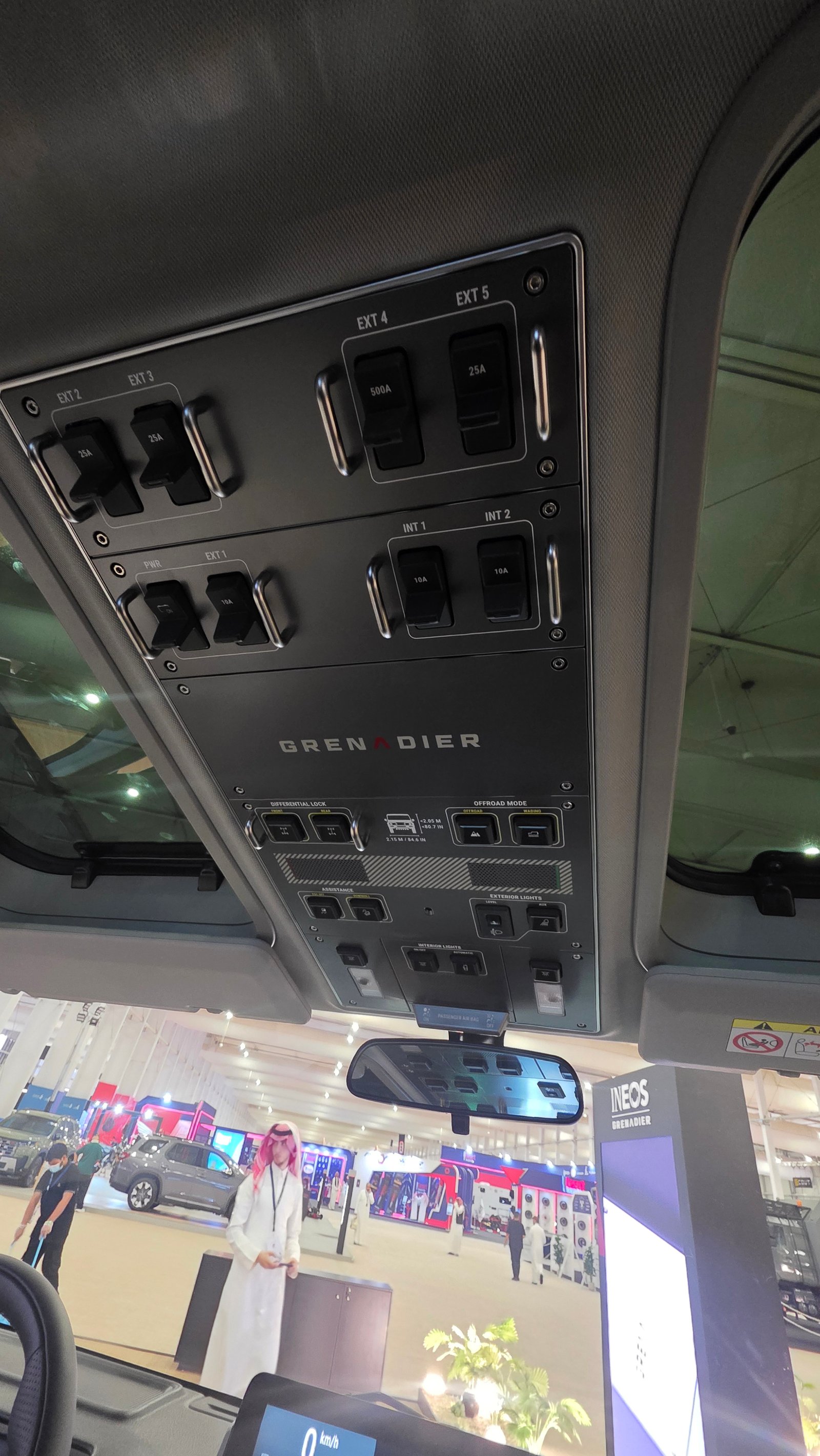
INEOS Trialmaster models add front and rear differential locks on top of the standard centre differential lock. The switches are mounted in the distinctive overhead control panel shown in our original photo.