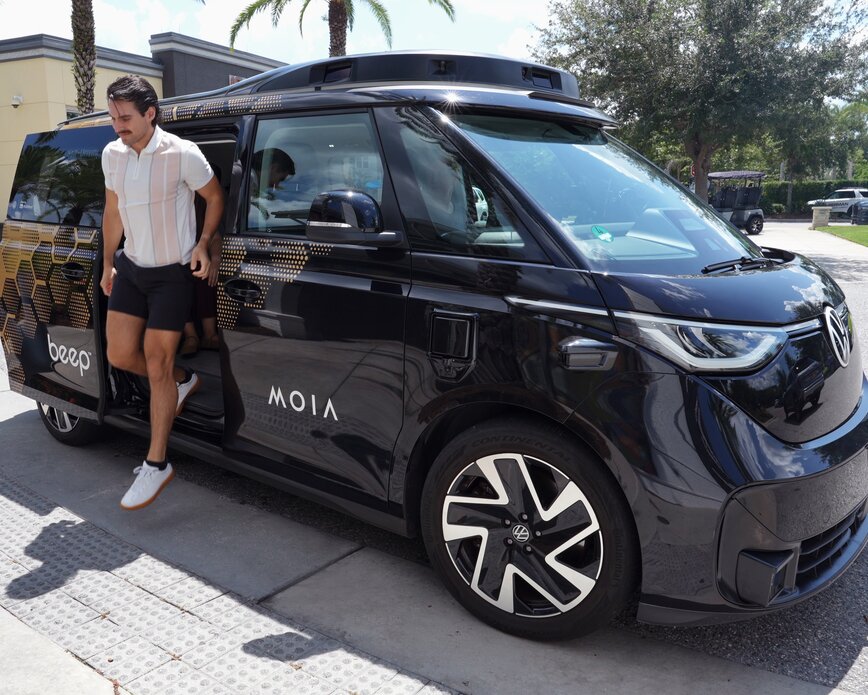
Passengers are riding, but this is still a supervised test phase. Invited users book through Beep, use designated stops on planned routes, and ride with highly trained onboard human operators.
How the Lake Nona passenger program works
Invited riders request trips through the Beep mobile app. The service uses dedicated pickup and drop-off points on three planned routes in the Lake Nona community. MOIA says vehicles are operating at full traffic speeds during this phase.
The goal is not only to move passengers but also to collect operational feedback: how riders interact with autonomous transport, how the service fits into a community network, and what is required to operate an autonomous mobility fleet in day-to-day conditions.
What is the autonomous ID. Buzz?
The MOIA ID. Buzz AD is based on the long-wheelbase Volkswagen ID. Buzz but is modified for autonomous ridepooling. MOIA’s production-vehicle description lists a Mobileye self-driving system plus 13 cameras, nine LiDAR sensors and five radar sensors, along with redundant braking, steering and power-supply systems.
MOIA has described the vehicle as designed for Level 4 autonomous operation. That should not be confused with the current Lake Nona operating mode: during the September 2026 passenger phase, trained human operators remain onboard.
What each partner contributes
| Partner | Role |
|---|---|
| MOIA America | Turnkey autonomous mobility solution, ID. Buzz vehicles, MaaS platform, operator training and deployment support |
| Mobileye | Self-driving system used by the ID. Buzz AD |
| Beep | Local autonomous mobility operations, Beep app, deployment and rider-facing service in Lake Nona |
| Volkswagen Group | Vehicle platform and wider group backing for MOIA |
How Orlando differs from Wayve + Uber in London
| MOIA + Beep, Lake Nona | Wayve + Uber, London | |
|---|---|---|
| Vehicle | Volkswagen ID. Buzz AD | Ford Mustang Mach-E |
| Rider access | Invited passengers | Eligible Uber riders can be matched |
| Booking | Beep app | Uber app |
| Operating pattern | Dedicated stops on three planned routes | Trips across London except airports at launch |
| Human onboard | Highly trained human operator | Trained TfL-licensed private-hire driver |
Both are useful examples of supervised autonomous deployment, but they use different vehicles, operating areas, rider-access models and technology stacks.
Is it a Level 4 robotaxi?
The hardware and automated-driving system are intended for Level 4 use, but the current passenger operation remains supervised. Level 4 describes a system that can perform the driving task and fallback without a human driver inside its operational design domain. A test program can use Level 4-capable technology while still keeping human operators onboard during validation and rollout.